With longer work hours and rising living costs, many hourly workers wonder if there’s relief coming on taxes for overtime pay.
Headlines about “no tax on overtime” have created confusion about whether this change has started and what it actually means for your paycheck.
Here’s the current situation as of mid-2026: A new federal deduction for qualified overtime pay is in effect, but it’s not a complete elimination of taxes on all overtime earnings.
This article explains the details, eligibility, limitations, and what it really means for your take-home pay.
What Is the “No Tax on Overtime” Provision?
In July 2025, the One Big Beautiful Bill Act was signed into law. Among its provisions is a temporary above-the-line deduction for qualified overtime compensation.
This allows eligible workers to deduct a portion of their overtime pay from their taxable income on federal tax returns. It applies retroactively to tax year 2025 and runs through 2028.
Important clarification: This is not a full exemption from all taxes on overtime. It primarily targets the premium portion (the extra “half” in time-and-a-half pay required under the Fair Labor Standards Act).
Regular wages and the base portion of overtime remain taxable, and payroll taxes like Social Security and Medicare still apply in full.
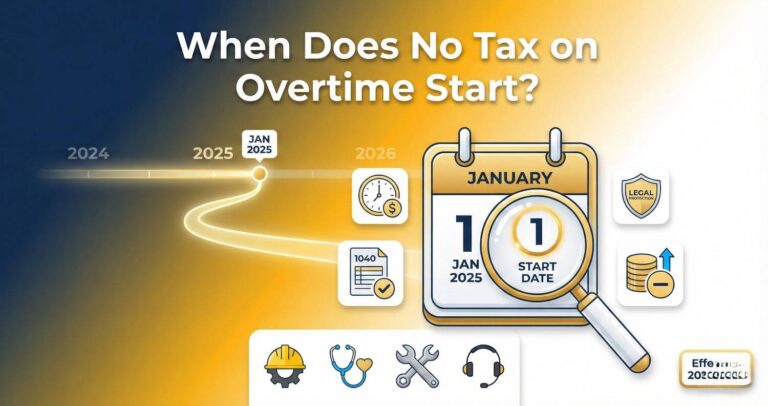
When Did No Tax on Overtime Start?
The deduction took effect for tax year 2025 (retroactive to January 1, 2025). You can claim it when filing your 2025 taxes in early 2026 and for subsequent years through 2028.
Employers began adjusting reporting for 2026, with updated W-2 forms showing qualified overtime amounts separately.
There is no change to withholding on paychecks immediately in all cases, but the deduction reduces your final tax bill when you file.
Key Details and Eligibility
The deduction is capped at $12,500 for single filers ($25,000 for married filing jointly) per year. It phases out for higher earners – modified adjusted gross income above $150,000 single / $300,000 joint.
Only overtime required under FLSA (typically 1.5x pay for hours over 40 per week) qualifies; voluntary or holiday premium pay often does not.
Both employees and certain self-employed individuals may qualify, and the deduction is available whether you itemize or take the standard deduction.
State taxes are not automatically affected – only federal income tax.
The Overlooked Nuance: Deduction vs Full Exemption
Many workers expect their entire overtime check to become tax-free. In reality, only the premium portion is deductible, and there are income limits and caps.
Social Security and Medicare taxes continue to apply fully, meaning your actual take-home boost is meaningful but more modest than some headlines suggest.
Employers must now track and report qualified overtime separately, adding some administrative complexity.
Looking ahead, the provision sunsets after 2028 unless extended by future legislation. Tax policy changes frequently, so staying informed through official IRS channels is essential.
Practical Considerations and Common Misunderstandings
A frequent mistake is assuming all overtime pay is now untaxed or that the change affects your paycheck withholding dramatically right away.
Many overlook the phase-out for higher earners or the distinction between required FLSA overtime and other premium pay. Others fail to track their qualified overtime separately for accurate filing.
Risks include overestimating your savings and budgeting accordingly, or missing the deduction entirely when filing.
Consult a tax professional or use updated tax software, especially if your income is near the phase-out thresholds or you have complex employment arrangements.
Is This Change Right for Your Situation?
For hourly workers putting in consistent overtime below the income caps, this deduction provides welcome relief and extra take-home money at tax time.
It particularly benefits middle-income essential and blue-collar workers in industries with frequent overtime. However, for high earners or those with minimal overtime, the impact may be limited.
If you’re considering career moves involving more overtime, factor this in alongside overall compensation, work-life balance, and long-term earning potential.
The temporary nature of the provision also means planning for its possible expiration after 2028.
FAQs
Conclusion
As of 2026, the “no tax on overtime” provision is active as a limited federal income tax deduction for qualified overtime pay covering tax years 2025–2028.
It does not eliminate all taxes on overtime but offers meaningful relief for many hourly workers by allowing a deduction on the premium portion, subject to caps and income limits.
Stay informed through official IRS resources rather than social media headlines. Track your qualified overtime carefully, and consider professional tax advice to maximize the benefit.
While not a complete game-changer for everyone, it represents real support for working Americans putting in extra hours.
