If you’ve been searching for jobs lately, you’ve probably noticed “Remote” appearing in more and more adverts.
A lot of Nigerians are asking the same questions: what does a remote job actually mean, is it the same as working from home, and can you really work from Nigeria and get paid in dollars?
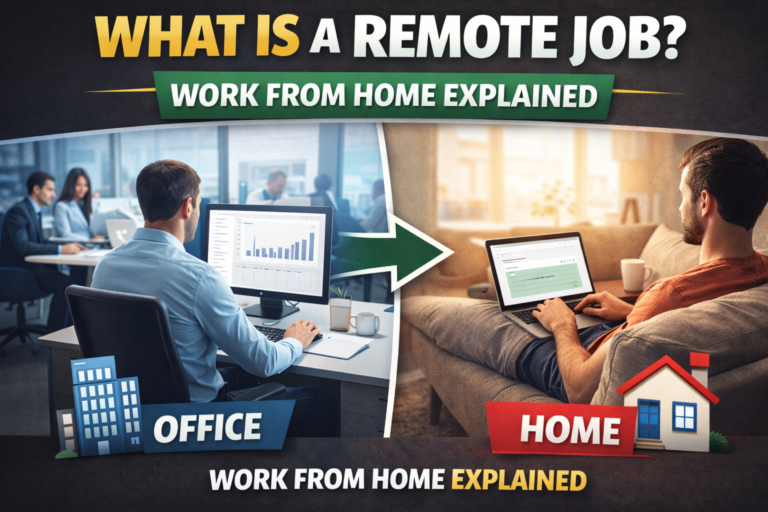
A remote job is a position where you perform your work outside the company’s physical office. You don’t commute to a location every day – instead, you work from your home, a co-working space, a café, or anywhere with a stable internet connection. Communication happens through email, Slack, Zoom, or WhatsApp.
You’re given tasks with deadlines and expected to deliver results, not just be physically present for eight hours.
Remote work expanded significantly during the COVID-19 pandemic and has continued growing since.
Understanding the different types and what each actually requires will help you identify the right opportunities and avoid applying for roles that don’t fit your situation.
What Does a Remote Job Actually Mean?
A remote job means:
- You work for a company (local or international) without going to their office.
- Communication happens through the internet (email, Slack, Zoom, Microsoft Teams, WhatsApp, etc.).
- You are usually given tasks with deadlines.
- You are expected to deliver results, not just sit down for 8 hours.
Some companies allow fully remote work (you can work from any country), while others offer hybrid remote, meaning you work from home most days but may be required to come to the office once or twice a week.
Types of Remote Jobs
Remote job adverts use specific terms that mean different things in practice.
Understanding the difference matters because it affects your daily schedule, location requirements, and whether you’re eligible to apply from Nigeria at all.
| Type | What It Does | How It Works (Nigeria Context) |
|---|---|---|
| Fully Remote | All contracted hours are completed outside the workplace; no expectation to come into an office | This is the true work-from-home model. You may be hired by a Lagos-based firm or a company in the U.S. and work entirely from your home, anywhere in Nigeria. |
| Hybrid | Splits time between working from home and working on-site | You might go into the office in Victoria Island for two days (e.g., for meetings) and work from home for the other three days. |
| Remote-First | Remote work is the default for everyone across the company | All policies and meetings are designed with a remote team in mind. This is common with global tech companies hiring from Nigeria. |
| WFH (Flexible) | You are permitted to work from home occasionally, often on an ad-hoc basis. | You have a desk at the office, but your contract allows you to work from home on certain days (e.g., for childcare or maintenance issues). |
A Note on “Work From Anywhere” (WFA)
Some global companies offer true location independence.
However, be aware that “remote” in Nigeria may still require you to live within a specific time zone (e.g., +/- 1 hour UTC) or a fixed location like Lagos to attend occasional physical meetings
Benefits of Remote Work for Nigerian Professionals
The most immediate benefit for most Nigerians is eliminating commute costs and time – particularly high in Lagos and Abuja, where traffic is a serious daily drain on both.
Beyond that, remote work opens access to foreign companies paying in dollars or pounds, which at current exchange rates represents a meaningful income upgrade compared to equivalent local roles.
Location flexibility is another genuine advantage. Remote work means you’re not forced to relocate to Lagos or Abuja to access better-paying jobs – a real consideration for professionals in other states who previously faced the choice between career opportunities and where they wanted to live.
Better work-life balance and flexible hours also feature consistently in why Nigerian professionals prefer remote roles where available.
The Real Challenges to Plan For
Electricity and internet reliability are the most significant practical barriers for Nigerian remote workers – not soft challenges, but hard operational constraints that will directly affect your employment if not managed.
Most serious remote employers expect near-constant availability during agreed hours, and unexplained outages affect your reputation quickly. This is why investment in power backup and multiple internet sources is essential before applying, not after.
Time zone differences with US and UK companies are manageable but require honest planning upfront. Many roles with American companies expect overlap with Eastern or Pacific time, which means evenings in Nigeria.
If that doesn’t suit your household situation, filtering for roles with African or European time zone requirements is worth doing early in your job search rather than discovering the conflict after an offer.
One less-discussed reality: some international companies apply geographic pay differences, offering lower rates to remote workers in Africa than for the same role in the US or Europe.
This is legal and common, but worth researching before accepting an offer. Platforms like Levels.fyi, Glassdoor, and LinkedIn Salary can give you reference points for what the same role pays globally.
What You Need Before Applying for a Remote Job
To succeed in a remote job, you should have:
- A reliable laptop
- Stable internet (at least 4G or fibre broadband)
- Good power backup (inverter or generator)
- Quiet workspace
- Strong self-motivation and time management skills
- Good communication skills (especially written English)
Sample Job Description Language
You will often see these lines in remote job adverts:
- “This is a fully remote position.”
- “100% remote – work from anywhere.”
- “Remote job for candidates in Nigeria.”
- “We are hiring remote workers across Africa.”
What Actually Makes Nigerian Remote Workers Succeed
The most reliable remote workers in Nigeria don’t just have good skills – they have reliable systems. That starts with a dedicated workspace.
Working from your bed or kitchen table blurs the mental boundary between work and personal time in ways that accumulate into real productivity and discipline problems.
A separate desk, even in a corner of a room, creates a physical “clocked in” signal that matters more than it sounds.
Over-communicating with your team is the other habit that separates remote workers who get promoted from those who get sidelined. In a physical office, your manager can see you working. Remotely, they can’t – so assume no one knows your progress unless you’ve told them.
Brief daily or weekly updates on what you’ve done, what you’re working on, and any blockers build the visibility that in-office workers get automatically.
On rates: if you’re doing a job for a company in the US or UK, your starting point for rate negotiation should be global market rates for that role, adjusted by your experience – not Nigerian local market rates.
Many Nigerian remote workers undersell themselves significantly in early negotiations.
Research what the role pays globally before you receive an offer, so you’re negotiating from a position of information rather than accepting whatever is first offered.
FAQs
Conclusion
Remote work is a genuine career opportunity for Nigerian professionals – not a trend that’s fading.
The access it provides to foreign companies, dollar-denominated salaries, and location flexibility represents a real income and lifestyle upgrade for those who approach it practically rather than assuming it’s straightforward.
The foundation is the same whether you’re applying for your first remote role or your fifth: reliable infrastructure, strong communication habits, and an honest assessment of what each role actually requires before you apply.
Get those three things right and remote work becomes a career advantage, not just a working arrangement.
