Earning $100,000 a year feels like a major milestone for many professionals in the United States.
It often represents the threshold where career progress starts delivering a noticeably better lifestyle – or so it seems on paper.
Yet once taxes, deductions, and real-world expenses hit, that six-figure salary can feel surprisingly different month to month.
This guide breaks down exactly how much $100,000 translates to after taxes for most American workers.
We’ll look at realistic take-home pay across different scenarios, the factors that swing your numbers significantly, and whether this income level truly supports the lifestyle most people expect in today’s economy.
What Does $100,000 a Year Actually Mean After Taxes?
A $100,000 annual salary breaks down to roughly $8,333 per month before any deductions.
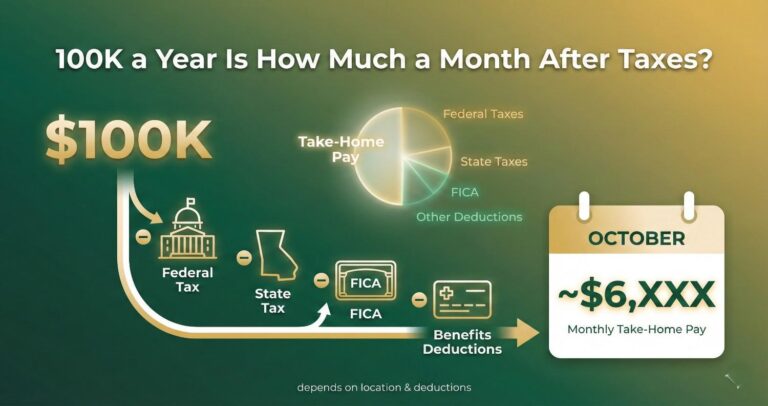
After federal income taxes, state taxes, Social Security, Medicare, and common benefits like health insurance or retirement contributions, most single filers in moderate-tax states see their monthly take-home pay land between $5,800 and $6,500.
That range can shift dramatically depending on where you live and your personal situation.
This isn’t just about the raw math. Understanding your real disposable income helps with everything from budgeting and housing decisions to evaluating job offers and planning long-term financial goals.
The gap between gross and net pay often surprises people moving into higher tax brackets for the first time.
Breaking Down the Taxes on a $100,000 Salary
For 2026, federal income tax brackets place a single filer earning $100,000 in the 22% marginal bracket, with some income taxed at 12% and lower rates.
On top of that, you have 6.2% for Social Security (up to the wage base limit) and 1.45% for Medicare. Many states add their own income taxes, ranging from 0% in places like Florida and Texas to over 10% in California or New York.
Additional common deductions include pre-tax 401(k) contributions, health insurance premiums, and sometimes commuter benefits or HSA contributions.
These can meaningfully lower your taxable income and boost your take-home pay.
Realistic Monthly and Annual Take-Home Estimates
Here’s what $100,000 typically looks like in practice for different scenarios:
| Scenario | Effective Tax Rate (approx.) | Annual Take-Home | Monthly Take-Home |
|---|---|---|---|
| Single filer, low-tax state (e.g. Texas or Florida) | 22-25% | $75,000 – $78,000 | $6,250 – $6,500 |
| Single filer, average-tax state | 25-28% | $72,000 – $75,000 | $6,000 – $6,250 |
| Married filing jointly, moderate state | 20-24% | $76,000 – $80,000 | $6,333 – $6,667 |
| High-tax state (e.g. California or New York) | 30-35% | $65,000 – $70,000 | $5,417 – $5,833 |
Biweekly paychecks (common for salaried employees) would typically range from about $2,700 to $3,100 after taxes, while weekly pay falls in the $1,350–$1,550 range depending on location and deductions.
Hourly Perspective and Lifestyle Context
Assuming a standard 40-hour workweek (2,080 hours per year), $100,000 equates to roughly $48 per hour gross.
After typical taxes and deductions, your effective hourly take-home often lands around $35–$38. This perspective helps when comparing salary offers or side hustles.
In many mid-sized American cities, this income supports a comfortable single- or dual-income household with room for savings, vacations, and homeownership.
In high-cost coastal cities, however, rent, childcare, and transportation can consume a much larger share, sometimes leaving less breathing room than expected.
The Overlooked Reality: Effective Tax Rates vs Marginal Rates
One of the most misunderstood aspects of earning $100,000 is the difference between your marginal tax rate (the rate on your next dollar) and your effective tax rate (the actual percentage you pay overall).
Many people see the 22% or 24% federal bracket and assume they lose nearly a third of every paycheck. In reality, progressive brackets and deductions usually result in an effective rate of 22–28% for most single filers at this level.
Looking ahead, potential changes to tax policy, inflation adjustments to brackets, and rising costs for Social Security and Medicare could shift these numbers in the coming years.
Anyone in this income range should also consider the 3.8% Net Investment Income Tax if they have significant investment income, and the Additional Medicare Tax on earnings above certain thresholds.
Practical Considerations and Common Mistakes
Many professionals new to a six-figure income make predictable errors. They overestimate their take-home pay and fall into lifestyle creep – upgrading their car, apartment, or spending habits before accounting for taxes and future savings goals.
Others forget to factor in self-employment taxes if they’re contractors, or they underutilize pre-tax accounts that could save thousands annually.
Risks include overcommitting to expensive housing in high-cost areas, failing to build an emergency fund, or ignoring long-term retirement contributions.
Beginners often overlook how state taxes and local costs interact with federal taxes, leading to unpleasant surprises when they move or change jobs.
Always run personalized estimates using tools like paycheck calculators or consult a tax professional, especially if you have complex situations such as stock options, bonuses, or side income.
Is $100,000 a Good Salary in 2026?
Whether $100,000 feels like “good money” depends heavily on your location, family size, lifestyle expectations, and debt load.
In many Southern and Midwestern cities, it provides solid financial security and strong saving potential.
You can realistically afford homeownership, family vacations, and meaningful retirement contributions.
In expensive metros like San Francisco, New York, or Boston, the same salary can feel stretched thin after housing and childcare costs.
For households with two earners or no children, it still offers substantial comfort. Single parents or those supporting extended family may find it more challenging.
Ultimately, it’s a high income that rewards careful financial habits but doesn’t automatically guarantee wealth without planning.
FAQs
Conclusion
A $100,000 salary delivers a meaningful step up in earning power for most Americans, typically translating to $5,800–$6,500 per month after taxes.
This level of income opens doors to greater financial flexibility, but the real benefit comes from understanding exactly what lands in your bank account and making deliberate choices with it.
Focus on maximizing deductions, living below your means, and building multiple income streams or investments.
Six figures is an excellent foundation – what you do with the net amount determines whether it leads to lasting financial security or simply higher spending.
