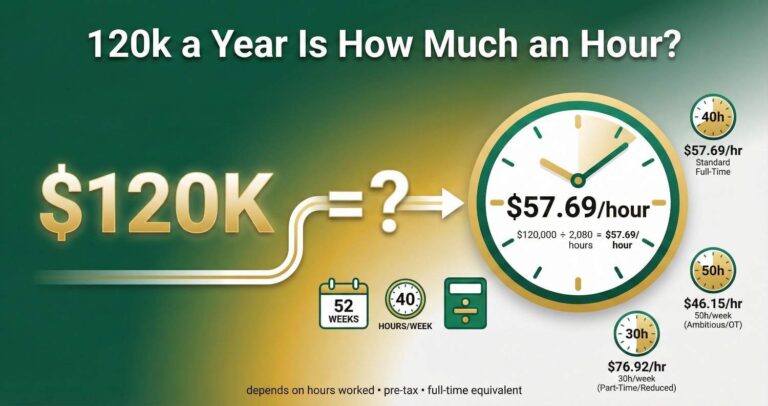
A $120,000 salary often sounds straightforward until you try to translate it into something more practical like hourly pay.
The confusion usually comes from the fact that most people don’t actually work a clean, uninterrupted 40-hour week all year round.
Once you account for standard working hours, holidays, and how employers structure time, the hourly figure becomes clearer, but also slightly more nuanced than a simple division suggests.
How $120K a Year Converts to Hourly Pay
On a standard full-time schedule of 40 hours per week over 52 weeks, a typical work year comes to 2,080 hours. Using that baseline, $120,000 divided by 2,080 equals approximately $57.69 per hour.
This figure represents gross pay, meaning it does not account for taxes, unpaid leave, or any benefits deductions.
In real working conditions, your effective hourly rate can shift depending on how many hours you actually work and how your employer structures compensation.
Monthly, Weekly, and Daily Breakdown
| Time Period | Gross Amount |
|---|---|
| Yearly | $120,000 |
| Monthly | $10,000 |
| Biweekly | $4,615 |
| Weekly | $2,308 |
| Daily (5-day week) | $461 |
| Hourly | $57.69 |
These values assume a consistent work schedule throughout the year. In practice, time off, unpaid holidays, and overtime can make your actual earnings per hour slightly higher or lower depending on your situation.
Why Hourly Conversion Is Not Always Straightforward
One common mistake is assuming that annual salary automatically reflects real working conditions. Many salaried roles include unpaid overtime, meaning you may work more than 40 hours per week without any increase in pay.
On the other hand, some jobs offer flexibility, paid time off, or reduced workloads during certain periods, which effectively increases your real hourly value.
This is why two people earning the same $120,000 salary can have very different lived experiences in terms of workload and compensation fairness.
What $120K Looks Like After Taxes
Taxes significantly affect how much of a $120,000 salary you actually take home. Depending on your country, state, and filing status, deductions can include federal income tax, state tax, Social Security, and Medicare contributions.
In many U.S. scenarios, estimated take-home pay typically falls between $85,000 and $95,000 annually. That translates to roughly $7,000 to $8,000 per month, although this varies widely based on personal circumstances and local tax rates.
Is $120,000 a Good Salary?
In most regions, a $120,000 salary is considered above average and places you in an upper-middle income bracket.
It generally supports a comfortable lifestyle, savings potential, and financial stability, especially in moderate cost-of-living areas.
However, location plays a major role in how far that income goes. In high-cost cities such as New York, San Francisco, or Los Angeles, the same salary may feel significantly less flexible due to housing and living expenses.
What Most People Overlook About Hourly Salary Conversions
A key detail many people miss is that hourly calculations assume a perfect 40-hour workweek with no variation.
In reality, salaried employees often work beyond contracted hours, attend unpaid meetings, or handle responsibilities outside standard schedules.
This means the real “effective hourly rate” can be lower than the calculated $57.69. At the same time, benefits like health insurance, retirement contributions, and paid leave can add significant value that is not reflected in hourly math but still impacts total compensation.
Is $120K Right for Your Lifestyle?
Whether $120,000 is a strong income depends less on the number itself and more on your financial obligations and expectations.
For someone with low fixed expenses, it can create strong savings potential and financial breathing room.
For someone living in a high-cost area or supporting dependents, it may feel more constrained despite being objectively high.
The real question is not just what you earn, but how your income aligns with your cost of living and work demands.
FAQs
Conclusion
A $120,000 annual salary converts to about $57.69 per hour under standard full-time assumptions.
While this provides a useful baseline, it does not fully reflect real working conditions, taxes, or benefits.
In practice, your actual financial experience depends on how many hours you truly work, how much tax you pay, and the value of benefits included in your compensation package.
These factors often matter just as much as the headline salary figure itself.
