Landing a solid salary is exciting, but watching a big chunk disappear to taxes and National Insurance can feel frustrating.
Many UK employees have discovered a legal way to keep more of their earnings while gaining valuable benefits: salary sacrifice.
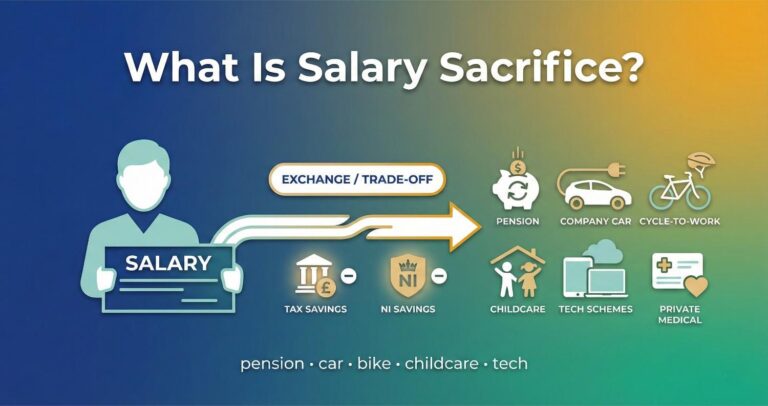
This arrangement lets you exchange part of your gross pay for non-cash perks, often resulting in meaningful tax and National Insurance savings.
This guide explains exactly what salary sacrifice is, how it works in practice, the most popular schemes, and whether it makes sense for your situation.
We’ll cover the real benefits, potential pitfalls, and key considerations so you can decide if it’s worth pursuing with your employer.
What Is Salary Sacrifice?
Salary sacrifice, sometimes called salary packaging, is a formal agreement between you and your employer. You voluntarily give up a portion of your gross salary in return for a specific benefit provided by the company.
Because the reduction happens before tax and National Insurance are calculated, your taxable income drops, which can lower your overall tax bill.
It’s not a tax loophole – it’s a government-supported mechanism designed to encourage certain behaviours, such as saving for retirement, commuting sustainably, or accessing workplace benefits.
The most common uses in the UK include boosting pension contributions, leasing electric cars, and cycle-to-work schemes.
How Does Salary Sacrifice Work?
The process is straightforward. You agree with your employer to reduce your gross salary by a set amount. In exchange, they provide a benefit of equivalent value. Your payslip then shows a lower basic salary, and you receive the chosen perk tax-efficiently.
For example, if you earn £45,000 and sacrifice £4,000 into a pension, your official gross salary becomes £41,000. You pay income tax and National Insurance on the lower figure, while your pension pot grows by the full £4,000 (plus any employer contributions).
This “gross pay” advantage often delivers better value than contributing the same amount from your net pay.
Popular Salary Sacrifice Schemes in the UK
The most widespread application is additional workplace pension contributions.
By sacrificing salary to your pension, you benefit from immediate tax relief at your marginal rate and reduced National Insurance. Many employers also enhance the arrangement with extra contributions of their own.
Electric company car schemes have become extremely popular due to low benefit-in-kind (BIK) tax rates on electric vehicles.
Employees sacrifice part of their salary to lease a car, often saving thousands compared to buying or financing one personally. Cycle-to-work schemes allow you to get a bike and accessories tax-free, promoting healthier commuting.
Other options include private medical insurance, childcare vouchers (for legacy users), and even mobile phones or gym memberships in some packages.
Key Benefits of Salary Sacrifice
The primary advantage is the tax and National Insurance savings. By lowering your taxable income, you may drop into a lower tax band or simply pay less at your current rate. For higher and additional rate taxpayers, the savings can be substantial.
You also gain access to benefits you might not otherwise afford or would pay for with after-tax money.
Pension salary sacrifice is particularly powerful because it accelerates retirement savings while reducing your current tax burden.
Many employees report higher take-home efficiency and improved financial well-being when used thoughtfully.
The Overlooked Nuance: Impact on Future Entitlements
One aspect many people miss is how a reduced official salary can affect calculations for certain statutory benefits and loans. Mortgage lenders, for instance, usually assess affordability based on your contracted salary.
A long-term salary sacrifice could make it harder to borrow as much as you’d like. Similarly, statutory maternity pay, paternity pay, and other earnings-related benefits are calculated on your reduced salary, potentially lowering what you receive during time off.
Looking forward, salary sacrifice schemes for electric vehicles are likely to evolve as BIK rates change and government green policies shift.
Pension rules around annual allowances and lifetime allowances also continue to be adjusted, making professional advice increasingly important for high earners.
Practical Considerations and Common Mistakes
Many employees jump into salary sacrifice without fully modelling the impact. A frequent mistake is sacrificing too much and ending up with cash flow problems, especially if you have high fixed expenses.
Others fail to check how the lower salary affects employer pension matching, bonus calculations, or redundancy pay.
Beginners often overlook the need to review the arrangement annually or when life changes occur. Leaving a job mid-scheme can sometimes require repayment or early termination fees. High earners must also watch the annual pension allowance and potential tax charges on excess contributions.
Always run the numbers with a personalised calculator and speak to your HR team or an independent financial adviser before committing.
Is Salary Sacrifice Right for You?
Salary sacrifice tends to work best for employees who are comfortable with a lower headline salary in exchange for better overall value.
If you’re in a higher tax bracket, planning to buy an electric car, or trying to maximise pension contributions, the benefits are often clear and compelling. It can be an excellent tool for improving your financial efficiency without necessarily reducing your lifestyle.
However, if you’re planning a big mortgage application soon, expecting a baby, or need maximum flexibility with your cash, the reduced salary might create complications. Employees in lower tax bands or with unstable employment situations may find the advantages smaller.
Ultimately, it comes down to your personal priorities, tax rate, and long-term goals. Those who take time to model different scenarios usually make the most informed decisions.
FAQs
Conclusion
Salary sacrifice remains one of the most effective ways for UK employees to reduce their tax burden while gaining practical benefits.
When used for pensions or qualifying green transport options, it can deliver genuine long-term value and help bridge the gap between gross earnings and actual financial security.
Like any financial strategy, success depends on understanding the full picture rather than focusing only on the tax savings.
By weighing the pros and cons against your own circumstances and seeking appropriate advice, you can use salary sacrifice as a smart part of a broader plan to build wealth and improve your work-life benefits.
