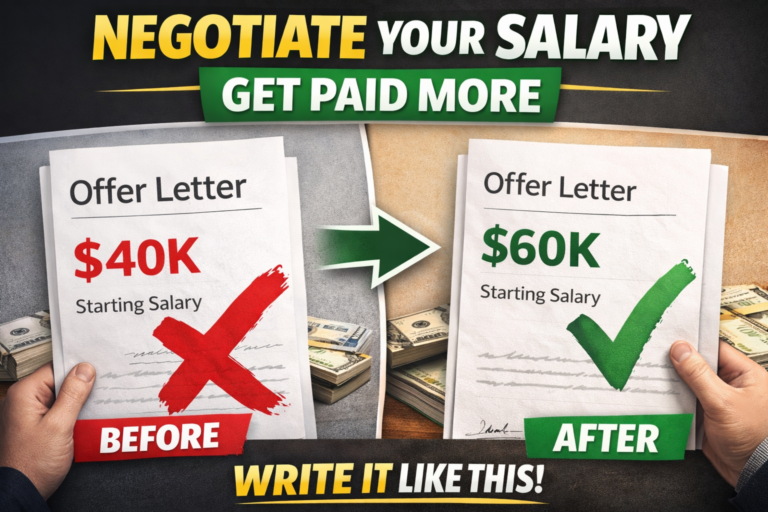
You aced the interview. The hiring manager is smiling. Then they ask: “What is your expected salary?” Or worse, they make an offer that is lower than what you need.
Many Nigerians freeze at this moment. They either accept too little out of fear or they quote a number that gets them rejected. Learning how to negotiate salary during an interview is a skill that can increase your lifetime earnings by millions of naira.
The truth is, employers often expect negotiation. If you do it right, you can increase your salary without risking the offer.
In this guide, you’ll learn exactly what to say, when to say it, and how to negotiate confidently.
Why Most Nigerians Do Not Negotiate (And Why You Should)
Common fears:
- “They will withdraw the offer if I ask for more.” (Rare, if you ask politely.)
- “I do not have enough experience to negotiate.” (Everyone can negotiate, even fresh graduates.)
- “The salary is fixed, so why bother?” (Many salaries have a range. You just have to ask.)
The reality is that the first offer is rarely the final offer. Companies expect a conversation. If you never ask, you will never know.
When Should You Negotiate Salary?
| When to Negotiate | When NOT to Negotiate |
|---|---|
| After they make you a formal offer (verbal or written) | During the first interview, before they show interest |
| When they ask “What is your expected salary?” – you can give a range | When you have already accepted the offer in writing |
| When you have another offer as leverage | When the job advert clearly stated, “salary is non‑negotiable.” |
| When you have unique skills they need | When you are desperate and have no other options |
The best time to negotiate is after they want you, not before. Once they say, “We would like to offer you the position,” you have leverage.
Step-by-Step Guide: How to Negotiate Salary Professionally
Step 1: Do Your Research Before the Interview
You cannot negotiate effectively without knowing what is fair.
Research:
- Average salary for similar roles in your city (Lagos, Abuja, Port Harcourt, etc.)
- Your industry and company size (a startup pays differently from a bank)
- Your experience level (entry, mid, senior)
Where to check in Nigeria:
- Jobberman salary reports
- MyJobMag salary surveys
- LinkedIn salary insights (for multinationals)
- Asking trusted colleagues or mentors
Also, consider the total package, not just base salary. Housing allowance, transport, HMO, pension (employer contribution), bonuses, leave days – all have monetary value.
Step 2: Never Give the First Number – If You Can Avoid It
When they ask, “What is your expected salary?” try to let them go first.
“I am flexible. Could you share the budgeted range for this role?”
If they insist, give a range, not a fixed number.
“Based on my research and experience, I am looking for something between ₦200,000 and ₦250,000 per month.”
The lower end should be a number you would actually accept. The higher end is your stretch goal.
Step 3: When They Make an Offer, Thank Them First
Do not immediately say “That is too low.” Show appreciation.
“Thank you very much for the offer. I am excited about the role and the team.”
Then pause. Ask for time if needed.
“Would it be possible to have 24 hours to review the full offer before giving my final answer?”
This gives you breathing room to prepare your counteroffer.
Step 4: Make a Specific, Justified Counter‑Offer
Do not just say “I want more money.” Explain why you deserve more based on:
- Your skills and experience
- Market rates for similar roles
- The value you will bring
“Based on my five years of experience in this exact industry and the fact that I would be bringing a pre‑existing client network, I was hoping for a salary of ₦350,000. Is that within your range?”
Use “I was hoping for” or “Based on my research” – not “I need” or “I demand.”
Step 5: Negotiate Beyond Base Salary If They Cannot Move on Pay
If the employer says, “The budget for this role is fixed at ₦180,000,” do not give up. Negotiate other things:
- Signing bonus (one‑time payment)
- Performance bonus (e.g., 10% of salary quarterly)
- Earlier salary review (e.g., after 3 months instead of 6)
- More annual leave days
- Flexible working hours or a hybrid option
- Professional development budget (courses, certifications)
- HMO coverage for family (not just employee)
Sometimes these “soft” benefits are easier for employers to approve than a salary increase.
Step 6: Get the Final Agreement in Writing
Once you agree verbally, ask for an updated offer letter or email confirmation.
“Thank you for agreeing to ₦210,000. Could you please send me an updated offer letter reflecting that? I am ready to accept.”
Do not resign from your current job or celebrate until you have the written offer.
What NOT to Do When Negotiating Salary
| ❌ Don’t | ✅ Do |
|---|---|
| Lie about another offer | Say, “I am considering another opportunity, but I prefer your company.” |
| Say “I need the money because of my problems.” | Focus on your value, not your needs. |
| Ultimatum (“Take it or leave it”) | Use collaborative language (“Can we work something out?”) |
| Negotiate after accepting the offer | Negotiate before you say “I accept.” |
| Compare yourself to a colleague | Use market data, not internal gossip. |
Sample Phrases: How to Negotiate Salary During an Interview
Corporate Job – Negotiation Over Phone or Email After Offer
Scenario: They called with an offer of ₦250,000. You want ₦300,000.

Script:

“Thank you so much for the offer, Mr. Adeyemi. I am really excited about the Marketing Officer role and the work your team is doing.

I have reviewed the offer, and I would like to discuss the salary. Based on my experience – five years in digital marketing and a track record of increasing engagement by over 50% in my last role – I was hoping for a monthly salary of ₦300,000.

Is that within your range? If not, perhaps we could look at a performance bonus or a salary review after three months.

I am very keen to join. Please let me know what is possible. Thank you.”Small Business / Startup – Direct, In‑Person Negotiation
Scenario: The owner says “We can pay ₦120,000.” You want ₦150,000.
Script:
“Thank you for the offer. I really like your business and I am excited about what we could achieve together.
I understand budgets can be tight. Based on the responsibilities you described – managing all social media and customer inquiries – similar roles in this area pay around ₦150,000.
Would you be able to meet me at ₦140,000? If not, could we add a small performance bonus after three months? I am open to finding a win‑win.”When Asked “What is your salary expectation?”
“I appreciate you asking. Based on my research and my 4 years of experience in this field, I believe a monthly salary in the range of ₦350,000 to ₦420,000 would be fair. However, I am flexible and more focused on the overall opportunity and growth with your company.”After Receiving a Job Offer
“Thank you very much for the offer. I am really excited about this opportunity and the chance to contribute to your team. However, after careful consideration, the offered salary of ₦280,000 is a bit lower than what I was expecting, considering my experience and the current market rate for this role.
Would it be possible to review the offer to ₦350,000? I am also open to discussing other benefits that can make the package more competitive.”When the Company Says the Salary is Fixed
“I understand the base salary is ₦300,000. I am very interested in this role. Could we explore other areas such as performance bonus, transport allowance, or a faster review period for promotion?”Polite Push for Higher Pay
“I truly value this opportunity. Given my track record of delivering results in my previous role, I was hoping for a starting salary closer to ₦400,000. Is there any flexibility on this?”Extra Tips for Salary Negotiation in Nigeria
- Be confident but respectful: Nigerian employers appreciate humility mixed with confidence.
- Don’t sound desperate: Never say “I really need this job” or “I have bills to pay.”
- Know when to stop: If they clearly state there’s no room for negotiation, don’t push too hard.
- Get everything in writing: Once you agree on salary and benefits, ask for an official offer letter before resigning from your current job.
- Fresh graduates: Your negotiation power is limited. Focus more on learning opportunities, allowances, and growth rather than high base pay.
- Timing: The best time to negotiate strongly is after they have shown a strong interest in you (usually in the final interview stage).
- Do not negotiate if the offer is already fair. If they offered you ₦250,000 and the market rate is ₦230,000–₦270,000, you can still ask, but be prepared for a “no.” Sometimes accepting graciously builds more goodwill.
- Use “we” language. “Can we find a way to make this work?” is better than “You need to pay me more.”
- Be ready to walk away. Your strongest leverage is the ability to say “no.” If you are desperate, you lose power. If the offer is truly too low, declining politely may even make them come back with a better number.
- Practise with a friend. Role‑play the conversation. It feels awkward at first, but practice makes it natural.
- Consider the economy. In a recession or a high‑unemployment period, employers have more power. Be reasonable. Asking for a 10–20% increase is normal. Asking for double may get you laughed at.
FAQs
Conclusion
Learning how to negotiate salary during an interview can significantly improve your earning potential. The key is preparation, confidence, and professionalism.
Know your value, communicate it clearly, and stay flexible during discussions. When done right, salary negotiation is not risky – it’s expected.
Master this skill, and you’ll not only get better offers but also start your job on stronger terms.
