Imagine retiring after decades of loyal service, only to discover your monthly income is locked in and protected from market crashes.
For many long-serving public sector workers and some private employees, this isn’t a fantasy – it’s the reality of a final-salary pension.
These schemes once represented the gold standard of retirement planning in the UK, offering a level of certainty that feels almost unimaginable in today’s volatile financial world.
This article explains exactly what a final salary pension is, how it works in practice, and whether it still deserves its strong reputation.
We’ll explore the mechanics, the significant advantages and very real limitations, and the critical decisions facing anyone who still holds one of these increasingly rare plans.
What Is a Final Salary Pension?
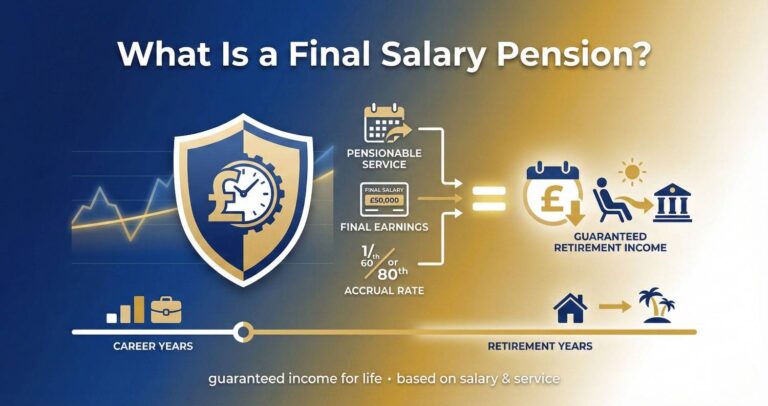
A final salary pension, also known as a defined benefit (DB) pension, is a workplace retirement scheme in which your employer guarantees you a specific level of income for life after you retire.
The amount is calculated using a formula based primarily on your earnings near the end of your career and the number of years you’ve been a member of the scheme.
Unlike modern defined-contribution pensions, the payout doesn’t depend on how well the invested funds perform. Instead, the employer (or the pension scheme) bears the investment risk and promises to deliver the agreed income no matter what happens in the financial markets.
This structure made final salary schemes highly attractive to employees but increasingly expensive and risky for sponsoring companies.
How Does a Final Salary Pension Work?
The core formula is straightforward but powerful: your annual pension is typically calculated as Final Salary × Years of Service × Accrual Rate. The accrual rate is usually expressed as a fraction, such as 1/60th or 1/80th of your final salary for each year worked.
Take a realistic example. A teacher with a final salary of £45,000 after 30 years in a scheme with a 1/60th accrual rate would receive £22,500 per year in retirement (before tax).
If the scheme offers inflation protection through increases linked to the Consumer Prices Index (CPI), that income retains much of its purchasing power over decades.
Many schemes also provide survivor benefits, meaning a spouse or partner can continue receiving a portion of the pension after the member’s death.
Payments usually start at the scheme’s normal retirement age (often 60–65), though early retirement is sometimes possible with reduced benefits.
The guaranteed nature of the income provides enormous peace of mind, particularly for those worried about outliving their savings.
Key Features of Final Salary Pensions
These schemes stand out because of their predictability and built-in protections. The income is guaranteed for life, often increases with inflation, and the employer carries the investment risk.
Many also include valuable death-in-service benefits and spouses’ pensions that provide security for families.
However, they are far less common today. Most private sector employers closed their final salary schemes to new members in the 2000s and 2010s as rising life expectancy and low interest rates dramatically increased the cost of providing these promises.
Final Salary vs Defined Contribution Pensions
The contrast between final salary (defined benefit) and defined contribution (DC) pensions is one of the most important distinctions in modern retirement planning.
| Feature | Final Salary Pension | Defined Contribution Pension |
|---|---|---|
| Income Guarantee | Yes, fixed formula | No, depends on fund performance |
| Investment Risk | Employer / Scheme | Individual |
| Predictability | High | Low to moderate |
| Inflation Protection | Usually built-in | Depends on annuity purchase |
| Portability | Limited | High |
While DC schemes dominate today because they are cheaper for employers, they shift all the risk onto the employee.
Market downturns near retirement can significantly reduce your income, and many people underestimate how much they need to save.
Who Still Has Access to Final Salary Pensions?
You’re most likely to hold a final-salary pension if you work (or worked) in the public sector – teachers, NHS staff, civil servants, police, and firefighters – or joined a large private company before the major wave of scheme closures.
Some older private sector schemes still exist, particularly in industries like banking, manufacturing, and utilities, but they are increasingly rare for new hires.
Even within these schemes, benefits are often capped or career-average rather than purely final salary, reflecting efforts to control costs.
The Overlooked Challenge: Funding and Sustainability
One crucial aspect many people miss is the growing pressure on these schemes. Longer life expectancies mean schemes must pay out for more years than originally anticipated.
Low interest rates have also inflated the present value of future liabilities, forcing employers to make large deficit payments.
While the Pension Protection Fund (PPF) provides a safety net for failed schemes, compensation is often lower than the full promised benefits, particularly for those below retirement age.
Practical Considerations and Common Mistakes
Many members misunderstand the value of their final salary pension and make expensive mistakes. One of the biggest is transferring out to a defined contribution scheme without fully understanding the trade-offs.
While a transfer value might look like a large lump sum, it rarely replicates the security of guaranteed lifelong income, especially with spousal benefits and inflation protection factored in.
Other common pitfalls include underestimating the impact of early retirement reductions, failing to consider tax implications when taking lump sums, or assuming the pension will automatically cover all retirement needs.
Beginners often overlook how inflation, even at modest levels, can erode the real value of fixed elements of the pension over 20–30 years.
Always seek independent financial advice before making major decisions – the rules around transfers are deliberately strict for good reason.
Is a Final Salary Pension Right for You?
If you already have significant final salary benefits, they usually form an excellent foundation for retirement. The guaranteed income reduces sequence-of-returns risk and gives you more flexibility with other savings.
However, if your pension represents only a small portion of your needs, you’ll still require additional DC savings or other income sources to maintain your desired lifestyle.
For younger workers or those with shorter service, the reality is different. Most new employees will rely entirely on defined contribution arrangements.
In these cases, understanding how to maximise employer contributions, manage investment strategy, and plan for longevity becomes far more important.
A final salary pension remains one of the best retirement deals available, but its rarity means most people must build their own security through disciplined saving and investing.
FAQs
Conclusion
Final salary pensions represent a different era of employment and retirement planning – one where employers took on substantial long-term commitments to reward loyalty and provide genuine security.
For those fortunate enough to still hold meaningful benefits, they remain among the most valuable assets in a retirement portfolio.
Yet the shift to defined contribution schemes reflects broader economic realities. Understanding both the strengths and limitations of your specific pension position is essential.
Whether you have a final salary scheme or not, taking proactive steps to understand your overall retirement picture will make the biggest difference to your financial wellbeing in later life.
