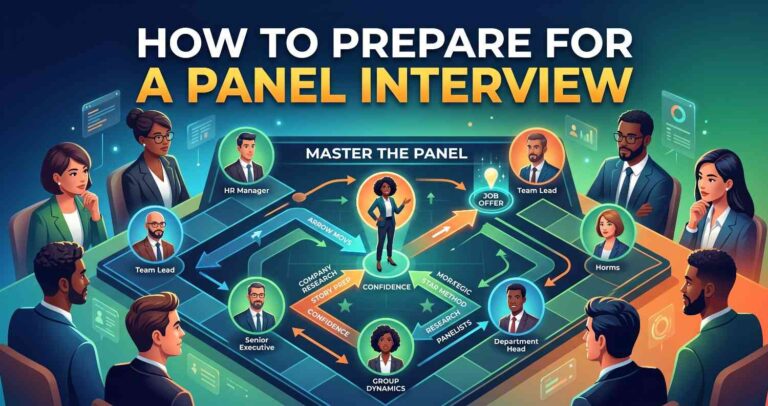
Walking into a room and finding three or four people sitting across the table ready to interview you simultaneously is an experience that catches many candidates off guard – even those who prepared carefully for a standard one-on-one conversation.
The dynamic is different enough from a regular interview that the same preparation approach produces noticeably different results.
Panel interviews are more common than most job seekers realize, particularly in government, education, healthcare, and larger corporate environments.
Understanding what they’re designed to evaluate, how to navigate the multi-person dynamic, and what distinguishes strong panel performers from weak ones is preparation that pays off in a format most people underestimate.
What Is a Panel Interview?
A panel interview is a format where you’re interviewed by multiple people simultaneously rather than one at a time.
The panel typically consists of two to five people – a combination of the hiring manager, potential colleagues, HR representatives, cross-functional stakeholders, or senior leadership, depending on the seniority and nature of the role.
The composition of the panel is deliberate. Each member usually evaluates you through a different lens – the hiring manager assesses whether you can do the job, a potential peer evaluates whether they’d want to work with you, HR assesses cultural and policy fit, and a senior stakeholder evaluates strategic alignment or leadership potential.
A strong panel performance means reading which lens each interviewer is using and tailoring your answers to speak to their specific concerns without ignoring the others in the room.
Panel interviews serve a practical purpose for employers: they’re more efficient than scheduling four sequential one-on-one interviews, they reduce individual interviewer bias by requiring consensus across multiple evaluators, and they create a more consistent experience across candidates.
For candidates, they’re more demanding – you’re managing multiple relationships and multiple evaluation criteria simultaneously in real time.
Is a Panel Interview a Good Sign?
Generally yes, panel interviews typically indicate that you’ve progressed past initial screening and the organization is investing significant time in evaluating you seriously.
Assembling multiple stakeholders for an interview requires coordination, and companies don’t do it for candidates they’re not genuinely considering.
That said, some organizations use panel interviews at earlier stages of their process as a standard format rather than a signal of advancement.
In government and public sector hiring particularly, panel interviews are often the first and only formal interview rather than a later-stage evaluation.
Understanding where the panel sits in the overall process matters more than the format itself as a signal of your standing.
How to Prepare for a Panel Interview
Find Out Who Will Be on the Panel
Ask the recruiter or hiring coordinator in advance who will be participating in the panel. Most will tell you – names, titles, and sometimes their relationship to the role.
Use this information to research each panelist on LinkedIn before the interview.
Understanding their professional background, how long they’ve been at the company, and what their role involves helps you anticipate the perspective they’ll be evaluating from and tailor your responses accordingly.
If you can’t get names in advance, ask at the start of the interview for a brief introduction from each panelist before questions begin.
Most panels expect this request and will accommodate it – and knowing each person’s role allows you to direct specific answers toward the most relevant person while maintaining eye contact with the full group.
Prepare Behavioral Examples With More Depth Than Usual
Panel interviews almost universally rely on structured behavioral questions – each panelist often comes prepared with a specific set of questions they’re responsible for, covering different competency areas.
The STAR method is the expected format for answers, and the depth of example required is higher than in a one-on-one conversation because your answer will be evaluated simultaneously by multiple people with different expertise and priorities.
Prepare six to eight strong examples from your experience before the interview, each covering a different competency – leadership, collaboration, problem solving, handling conflict, managing under pressure, delivering results, adapting to change, and influencing without authority are the most commonly assessed areas.
Having more examples than you’ll need means you can deploy the most relevant one for each question rather than reusing the same story across multiple answers, which panelists notice and which weakens the overall impression.
Practice Speaking to a Group
Answering questions to multiple people simultaneously feels different from answering one person, and the difference shows if you haven’t practiced it.
The most common mistake candidates make in panel interviews is directing their answer entirely to the person who asked the question and losing eye contact with the rest of the panel.
This reads as either social awkwardness or as prioritizing some panelists over others – both of which affect how the panel collectively perceives you.
The technique that works: begin your answer by making eye contact with the person who asked the question, shift naturally to other panelists as you develop your answer, and return to the questioner as you conclude.
This creates the experience of a conversation with the full group rather than a series of bilateral exchanges that leave some panelists feeling like observers.
Practice this with friends or family – even three people sitting across from you asking questions is useful rehearsal for the real format.
Prepare a Concise Introduction
Panel interviews almost always open with some version of “tell us about yourself” – and delivering that answer to a group of people who all need to follow it is different from delivering it to one person. Keep it to two minutes maximum.
Any longer and you’ll lose some panelists’ attention before the substantive questions have even started. Structure it clearly: your current or most recent role, your most relevant experience for this specific position, and why you’re interested in this opportunity.
End on the forward-looking note rather than dwelling on history.
How to Handle the Multi-Interviewer Dynamic
The practical challenge of panel interviews is managing attention across multiple people who may be taking notes, conferring quietly with each other, or showing varying levels of visible engagement at any given moment.
A panelist who appears distracted or unimpressed mid-answer can throw off less experienced candidates – don’t let it.
Panelists have different styles; some are note-takers who look down frequently while listening carefully, some are poker-faced evaluators who give little visible feedback, and some are warm and engaged throughout. None of those behaviors tell you reliably how the evaluation is going.
When panelists confer quietly with each other mid-interview, don’t interpret it negatively – they may be deciding who asks the next question, noting something to follow up on, or simply coordinating.
Stay focused on the person currently speaking to you and maintain a composed, professional demeanor regardless of what the panel is doing on their side of the table.
If two panelists ask questions that seem to conflict – one probing your independence and another emphasizing teamwork – that’s usually intentional. They’re testing whether you can hold nuanced positions.
Acknowledge both values and explain how you balance them in practice rather than choosing one to emphasize and abandoning the other.
Questions to Ask in a Panel Interview
The question period at the end of a panel interview is an opportunity most candidates underuse. With multiple people in the room, you can direct different questions to different panelists based on their specific roles – which produces richer answers and demonstrates that you were paying attention to who each person is rather than treating them as an undifferentiated group.
Directing a question about day-to-day collaboration to a potential peer, a question about team culture to the hiring manager, and a question about strategic priorities to a senior stakeholder is more effective than asking the same general question to the full panel and waiting to see who responds.
It shows social awareness, genuine curiosity, and preparation – three qualities that panel interviewers specifically value because they reflect how you’d actually operate in the organization.
Questions that work well in panel settings include: what does success look like in this role in the first year, what’s one thing you wish the previous person in this role had done differently, how does the team typically handle disagreement on priorities, what’s the biggest challenge facing the department right now, and what do you each find most rewarding about working here.
That last question, asked of the full panel, often produces candid and revealing answers from different vantage points simultaneously.
After the Panel Interview
Send individual thank-you emails to each panelist within 24 hours if you have their contact information – not a single group email, but separate messages to each person. Reference something specific from their contribution to the conversation in each email.
This level of personalization demonstrates attentiveness and reinforces the impression that you engaged with each person individually rather than addressing the panel as a bloc. It’s a small action that few candidates take, and it’s consistently noticed.
If you don’t have individual email addresses, ask the recruiter after the interview. Most will provide them for the purpose of follow-up, and asking signals professional courtesy rather than presumptuousness.
How Long After a Panel Interview Should You Hear Back?
Panel interviews take longer to debrief than one-on-one interviews because multiple people need to align on their evaluations – a process that requires scheduling time across several busy calendars.
Most organizations complete their panel debrief within three to five business days of the interview and communicate a decision or next steps within one to two weeks.
If the panel included senior stakeholders with heavy travel schedules or if the organization is in a complex decision-making period, the timeline can extend to three weeks or more without it being a negative signal about your candidacy.
Ask about the expected timeline at the end of the interview – most panels will give you a realistic estimate – and use that as your reference point before following up.
If the stated timeline passes without contact, a single polite follow-up email to the recruiter or hiring manager is appropriate.
Reiterate your interest in the role, thank them for the panel’s time, and ask if there’s a decision timeline update they can share.
Following up more than once without a response usually indicates the process has moved in a different direction, though it’s not always conclusive – some organizations have genuinely slow internal processes that affect candidate communication more than candidate standing.
Frequently Asked Questions
Conclusion
Panel interviews reward the same fundamentals as any interview – specific preparation, strong behavioral examples, genuine knowledge of the company and role – but add a layer of complexity that requires specific tactical preparation as well.
Managing eye contact across multiple people, directing tailored questions to specific panelists, and maintaining composure when the dynamic feels more formal or intense than a one-on-one conversation are all skills that improve with deliberate practice rather than natural ability.
The candidates who perform best in panel interviews are those who treat the multi-person format as an advantage rather than a complication – more people in the room means more opportunities to connect, more lenses through which to demonstrate different strengths, and a richer conversation than a single interviewer can produce.
Walk in having researched who will be there, with more behavioral examples than you’ll need, and with specific questions for specific people.
That preparation level is unusual enough that it consistently stands out.
