For anyone running a business, paying contractors, or working as a freelancer, tax forms are not something you can ignore.
Among the most commonly misunderstood documents are the 1099-NEC and 1099-MISC forms, which often confuse people because they look similar but serve very different purposes.
The confusion usually shows up at the worst possible time: tax season. One wrong form, or filing the wrong category of payment, can lead to corrections, delays, or even penalties.
Understanding how these two forms differ is not just about compliance – it also helps you keep your financial reporting clean and organized throughout the year.
What 1099-NEC and 1099-MISC Actually Represent
Both forms are part of the IRS reporting system for non-employee payments. In simple terms, they are used when a business pays individuals or entities who are not on payroll.
However, they track completely different types of income.
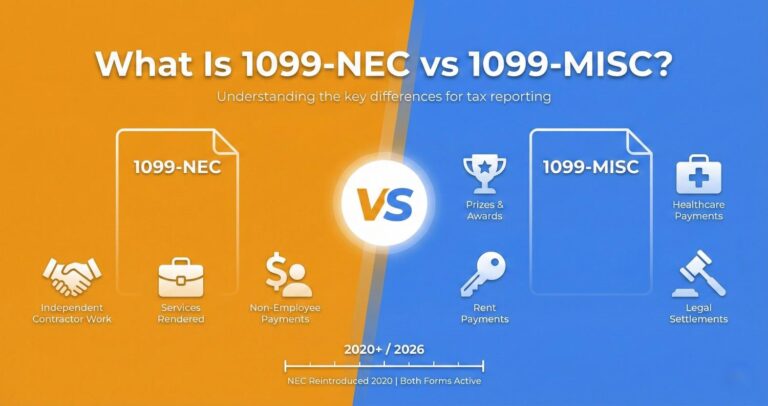
The 1099-NEC is focused strictly on payments made to independent contractors. The 1099-MISC, on the other hand, is used for a broader set of miscellaneous payments such as rent, royalties, and certain legal or prize-related payouts.
While they are often discussed together, they should not be treated as interchangeable.
The IRS split these reporting responsibilities to make contractor income easier to track separately from other types of miscellaneous business payments.
1099-NEC: Reporting Payments to Independent Contractors
The Form 1099-NEC (Nonemployee Compensation) is specifically designed for reporting money paid to self-employed individuals or contractors who provide services to your business.
It applies when a business pays at least $600 in a year to someone who is not classified as an employee.
This threshold is important because it determines whether reporting is required at all.
When You Must File 1099-NEC
You are generally required to issue a 1099-NEC if all of the following apply:
- You paid an individual or unincorporated business at least $600 during the tax year
- The payment was for services, not goods
- The payment was made as part of your business operations
This includes situations where you hire freelancers, consultants, or contract-based workers for tasks such as writing, design, development, or administrative support.
Common Examples of 1099-NEC Payments
The 1099-NEC typically applies to a wide range of service providers. These include freelance professionals who are not on payroll but work regularly with businesses.
- Freelance writers and editors
- Graphic designers and creative professionals
- Virtual assistants
- Software developers and contract engineers
- Marketing consultants and SEO specialists
A key detail many businesses overlook is that classification matters more than job title. What determines the form is not what someone does, but how they are paid and whether they are considered an employee or an independent contractor.
1099-MISC: Reporting Miscellaneous Payments
The Form 1099-MISC (Miscellaneous Information) is used for reporting income that does not fall under contractor compensation.
It captures a broader set of financial transactions that are still reportable to the IRS.
Unlike the 1099-NEC, this form is not focused on service-based freelance work. Instead, it covers specific categories such as rental payments, royalties, and certain legal or healthcare-related transactions.
When 1099-MISC Is Used
This form is commonly used for the following types of payments:
- Rent paid to property owners or landlords
- Royalties earned from intellectual property or publishing
- Prizes and awards that meet reporting thresholds
- Medical or healthcare-related payments
- Some attorney settlement payments
One important update in recent tax rules is that contractor payments were removed from this form and moved entirely to the 1099-NEC to reduce confusion in reporting business expenses.
Key Differences Between 1099-NEC and 1099-MISC
Although both forms deal with non-employee payments, they are structured to serve different reporting categories.
Mixing them up is one of the most common filing mistakes small businesses make.
| Feature | 1099-NEC | 1099-MISC |
|---|---|---|
| Primary purpose | Contractor payments for services | Miscellaneous income reporting |
| Typical recipients | Freelancers, consultants, contractors | Landlords, royalty earners, legal recipients |
| Payment threshold | $600 or more | Varies by category (often $10–$600) |
| Contractor services | Yes | No |
| Rent reporting | No | Yes |
| Filing deadline | January 31 | Later IRS deadline (varies by method) |
Filing Deadlines and Why Timing Matters
Deadlines for these forms are not identical, which is where many businesses run into problems. The 1099-NEC is due earlier than most other tax forms, both to the IRS and to the recipient.
Missing deadlines can lead to penalties that increase depending on how late the filing is. This makes early organization important, especially for businesses working with multiple contractors.
Why the IRS Split These Forms
Before 2020, contractor payments were reported alongside other types of miscellaneous income on the 1099-MISC form. This created confusion in reporting and often led to misclassification issues.
The IRS restructured the system by reintroducing the 1099-NEC to clearly separate contractor income from other types of payments. This change also aligned filing deadlines more consistently for self-employment income reporting.
In practice, the split makes it easier for both businesses and the IRS to track self-employment income more accurately.
Common Mistakes Businesses Make
Despite clear guidelines, filing errors are still common, especially for small business owners handling their own accounting.
- Using 1099-MISC for contractor payments instead of 1099-NEC
- Failing to collect a W-9 form before making payments
- Missing the $600 reporting threshold rule
- Filing after deadlines and triggering penalties
One often overlooked issue is assuming all payments to businesses require a 1099. In reality, classification rules depend on entity type, payment method, and tax status.
Is It Possible to Receive Both Forms?
Yes, depending on the type of income involved. A single business relationship may generate multiple forms if different types of payments are made.
For example, if you pay a contractor for services and also rent office space from them, each payment type would be reported separately using the appropriate form.
Who Typically Does Not Receive a 1099
Not all payments require 1099 reporting. Some common exceptions include payments made to corporations, employees, and transactions processed through certain third-party payment networks that are reported separately.
- Employees receiving W-2 wages
- Most incorporated businesses
- Payments processed through credit cards or payment platforms (often reported on 1099-K)
FAQs
Conclusion
Understanding the difference between 1099-NEC and 1099-MISC is essential for accurate tax reporting and avoiding unnecessary compliance issues. While they are often confused, each form serves a distinct purpose that aligns with specific types of income.
Businesses that take the time to correctly classify payments not only avoid penalties but also maintain cleaner financial records throughout the year.
For freelancers and contractors, knowing how these forms work helps you better understand how your income is reported and taxed.
