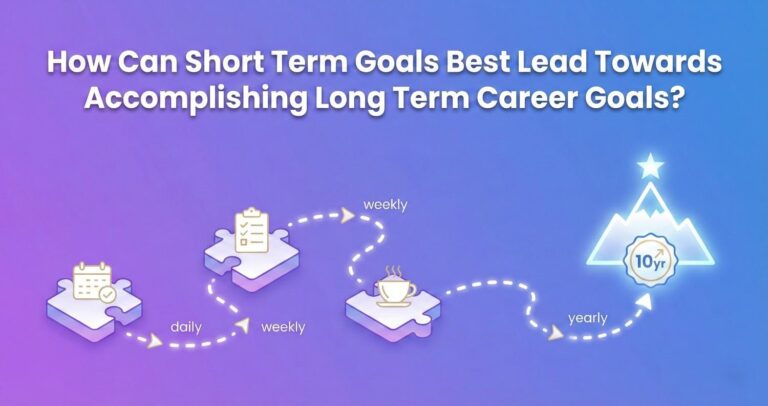
It’s a familiar pattern: you set a big career goal – land a senior role, hit a six-figure salary, start your own business – and then months later, you’re in the same place.
The ambition was real, but the progress wasn’t. That’s because long-term goals are great for inspiration but terrible for execution. They’re too distant, too abstract, and too easy to defer to “someday.”
Meanwhile, the people who actually make leaps aren’t necessarily more talented; they just understand that big outcomes are built from small, deliberate actions taken week by week.
This article explains how to bridge the gap between where you are and where you want to be using short-term goals.
We’ll cover a practical framework for turning any long-term career vision into a monthly action plan, explore the common pitfalls that derail even the best intentions, and help you decide whether this approach fits your work style.
Why Long-Term Goals Alone Leave You Stuck
Long-term goals are motivating – they give you a north star. But they’re also inherently flawed as execution tools.
A goal like “become a senior developer” or “earn $100,000 remotely” lacks a clear starting point, a timeline, and measurable milestones. Without those, your brain treats the goal as a distant aspiration rather than an immediate priority.
You tell yourself you’ll start next month, or after the holidays, or when you have more time. That delay becomes permanent.
The gap between intention and action is where most careers stall, not because of a lack of ability, but because of a lack of scaffolding around the goal.
What Short-Term Goals Actually Do
Short-term goals solve the problem of ambiguity. They convert “someday” into “this week.” They create urgency, provide daily direction, and give you a feedback loop – either you completed the task, or you didn’t.
Each completed short-term goal builds competence and confidence, which compounds over time. Moreover, short-term goals force you to prioritize.
When you break a long-term ambition into monthly chunks, you naturally identify the most critical skills and actions, filtering out the noise that consumes so much of our work hours.
Step 1: Define Your Long-Term Goal with Precision
Vague goals produce vague results. Instead of “I want to be a UX designer,” specify the role, the industry, the salary range, and the timeline.
For example: “I want to be a mid-level UX designer at a tech company, earning $100,000 per year, within 18 months.” This clarity makes the backward-planning process much easier.
If you’re unsure about the specifics, that’s okay, but then your first short-term goal should be research: talk to people in the field, read job descriptions, and identify the exact requirements.
Step 2: Identify the Skill Gaps
Once you know the destination, map the competencies required. For a UX designer, that might include Figma mastery, user research, wireframing, prototyping, and a portfolio of case studies.
For a freelance writer, it’s writing samples, niche expertise, client management, and proposal writing.
List every skill and credential that stands between you and the goal. This inventory becomes your curriculum. Don’t worry about perfection – you’ll refine it as you go.
The point is to have a tangible list of targets to tackle one by one.
Step 3: Convert Skills into Monthly Milestones
Now assign each skill to a 30-day block. Some skills take longer, but you can break them further.
The table below shows how a long-term goal translates into monthly short-term goals.
| Long-Term Goal | Short-Term Goal (30 days) |
|---|---|
| Become a UX Designer ($100k) | Complete Figma beginner course and recreate 3 screens |
| Build a strong portfolio | Finish 2 full case studies with user research |
| Get hired | Apply to 10 relevant jobs and tailor portfolio for each |
| Increase freelance income to $5k/month | Send 20 proposals and secure 2 new clients |
Each monthly goal is specific, measurable, and directly tied to the long-term outcome. This approach ensures that every week you’re either learning, building, or applying – never just waiting.
Step 4: Focus on Completion, Not Perfection
The biggest trap in goal-setting is perfectionism. You delay publishing your portfolio because it’s not “good enough,” or you postpone client outreach because you don’t feel ready.
Short-term goals break that paralysis because they’re low-stakes – finishing a course, sending a proposal, creating a draft. You can always iterate later. The key is to create a habit of output.
The person who finishes 10 imperfect projects will always outpace the person who waits for the perfect one. Accept that your early work will be rough; that’s how you learn and improve.
Step 5: Review and Revise Monthly
At the end of every month, conduct a brief review. Ask yourself: What did I complete? What skill improved the most? What obstacle got in the way? Then adjust the next month’s goals accordingly.
This review serves two purposes: it celebrates progress (which sustains motivation) and it corrects course before you drift off-track.
Sometimes you’ll realize your long-term goal itself needs recalibration – perhaps you discovered a different specialization or industry that excites you more. That’s fine.
The review process keeps you flexible while maintaining forward momentum.
The Hidden Pitfall: When Short-Term Goals Become Tunnel Vision
Most advice on goal-setting stops at breaking things down, but there’s a less-discussed downside: short-term goals can narrow your perspective too much. When you’re hyper-focused on monthly tasks, you might overlook emerging opportunities, shifting market demands, or your own changing interests.
For example, you might spend six months learning a specific programming language, only to find that the industry has moved toward a different stack. That’s why it’s crucial to build in “horizon scanning” as part of your review process.
Dedicate a small portion of each month to reading industry news, talking to mentors, and reassessing whether your long-term goal still makes sense.
Think of short-term goals as the engine, but the review process as the steering wheel – both are essential to reach the destination.
Another overlooked factor is the emotional side of goal pursuit. Short-term goals can create pressure if you tie your self-worth to each completion. Not every week will be productive; life happens. Build in buffer time and treat missed targets as data, not failure.
The most resilient career builders are those who adapt their plans without abandoning their ambition.
Is This Goal-Setting Approach Right for You?
This structured approach works best for people who thrive on clarity and measurable outcomes. If you’re someone who enjoys checklists, deadlines, and visible progress, you’ll likely find it motivating.
However, if you prefer a more organic, exploratory career path – where you follow curiosity rather than a rigid plan – you might find this framework too constraining. That’s not a flaw; it’s a difference in style.
The key is to adapt the framework to your personality: you can still set short-term goals, but make them exploration-based (e.g., “try three new skills this month and pick one to pursue”) rather than prescriptive.
Also consider your current career stage. Early-career professionals benefit enormously from skill-focused short-term goals because they’re building foundational competencies.
Mid-career professionals might prioritize networking, thought leadership, or strategic pivots – goals that are less about technical skills and more about positioning.
Tailor your monthly goals to your stage, and don’t be afraid to shift between skill-building, networking, and application phases as you progress.
FAQs
Conclusion
Long-term career goals give you direction, but short-term goals give you traction. The journey from ambition to achievement is built on a series of small, consistent actions – each one manageable, each one building on the last.
By breaking your big vision into monthly milestones, you transform an abstract dream into a practical to-do list. You stop waiting for the “right time” and start making time.
That said, the framework works best when you remain flexible. Your long-term goal might evolve, and your short-term goals should evolve with it. The review process is not a chore – it’s your opportunity to course-correct and stay relevant.
Ultimately, the people who succeed aren’t necessarily the ones with the grandest visions; they’re the ones who show up week after week, complete their small tasks, and let the compound effect do the rest.
Start with one month, one skill, one action. That’s all it takes to begin.
