You’ve made it through the interviews, the hiring manager has expressed strong interest, and the offer is on the table – pending a background check.
For most candidates, this is where the waiting starts, and the uncertainty sets in. How long will it take? What are they actually looking for? Is there anything on your record that could be a problem?
Background checks are a standard part of the hiring process across most industries, but they’re also one of the least explained.
Candidates rarely know what’s being checked, how long it takes, or what their rights are in the process. Here’s a clear breakdown of all of it.
How Long Does a Background Check Take?
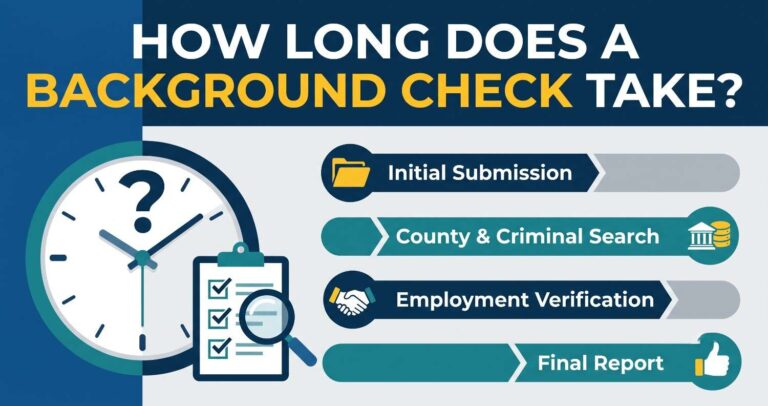
Most background checks for employment take between one and five business days to complete.
That’s the realistic range for a standard check covering criminal history, employment verification, and education verification run through a screening company. Some come back in 24 hours.
Others take two weeks or more, depending on what’s being checked and where the records are held.
The main factors that affect how long a background check takes are the scope of what’s being verified, the geographic reach of the search, how quickly third parties respond to verification requests, and whether any records require manual retrieval from courts or institutions that don’t have digital databases.
| Check Type | Typical Timeframe | What Can Slow It Down |
|---|---|---|
| Criminal history search | 1-3 business days | Manual court record retrieval, international records |
| Employment verification | 2-5 business days | HR departments slow to respond, defunct companies |
| Education verification | 1-3 business days | International institutions, older records not digitized |
| Credit check | 1-2 business days | Disputes or freezes on credit file |
| Professional license verification | 1-5 business days | Licensing boards with slow response times |
| International background check | 2-4 weeks | Varies significantly by country |
If your background check is taking longer than a week for a standard domestic check, it’s usually because a specific component – often employment verification or a county-level criminal record search – is waiting on a third party to respond.
This is common and doesn’t typically signal a problem with your record.
What Shows Up on a Background Check for a Job?
The specific contents of a background check depend on what the employer has ordered and which screening company they’re using, but most standard employment background checks cover some combination of the following:
Criminal History
This is typically the core component of any employment background check. It searches criminal records at the county, state, and sometimes federal level for the jurisdictions where you’ve lived and worked.
Felony and misdemeanor convictions appear, along with pending charges in many searches.
Arrests that didn’t result in convictions may or may not appear depending on the jurisdiction and the screening company’s practices.
How far back the search goes varies. Many employers limit criminal history searches to seven years, which is the maximum lookback period for criminal records in several US states. Others search the full available record.
The nature of the offense matters as much as whether one exists – a conviction that’s unrelated to the job function is treated differently from one that’s directly relevant to the role.
Employment History Verification
Employers verify the jobs you listed on your resume – typically confirming your job title, dates of employment, and sometimes your reason for leaving.
They don’t usually verify your salary unless you specifically authorize it, and they rarely get detailed performance information from former employers due to liability concerns.
What they’re checking is primarily that you worked where you said you worked, in the role you described, for the duration you stated.
Discrepancies between what you listed and what verification reveals are a significant red flag – not necessarily the discrepancy itself, but the fact that it wasn’t disclosed.
If there’s a gap in your employment history or a role where your title or dates don’t match exactly, it’s generally better to address it proactively in the hiring process than to let the background check surface it unexpectedly.
Education Verification
Education verification confirms that you attended the institutions you listed and received the degrees or certifications you claimed.
Fabricating academic credentials is one of the most common forms of resume fraud and one of the most reliably caught – universities respond to verification requests consistently, and the consequences of a falsified degree being discovered during a background check are typically immediate disqualification and sometimes termination, even if discovered after hiring.
Credit History
Employment credit checks are not the same as the credit checks lenders run. They show the general state of your credit – payment history, outstanding debts, bankruptcies, and public records – but they don’t show your credit score.
Employers are required to get your written authorization before running a credit check and can only use credit information in hiring decisions when it’s relevant to the role.
Credit checks are most common for roles involving financial responsibility – accounting, treasury, financial advising, banking – and for positions with access to significant company funds or assets.
Most employers in non-financial roles don’t run credit checks at all.
Identity Verification and Social Security Number Trace
A Social Security Number trace confirms your identity and generates a list of addresses associated with your SSN, which screening companies use to determine which jurisdictions to include in their criminal record searches.
It’s not a credit check – it doesn’t access your credit file – but it does verify that the identity information you provided matches official records.
Professional License Verification
For roles that require specific licenses or certifications – medical, legal, financial, engineering – employers verify that the license exists, is current, and is in good standing with the relevant licensing board.
This is straightforward if your credentials are accurate and current, and immediately disqualifying if they’re not.
Can an Employer Run a Background Check Without Your Consent?
In the United States, no – the Fair Credit Reporting Act (FCRA) requires employers to obtain your written consent before conducting a background check through a consumer reporting agency.
This consent is typically included in the paperwork you complete during the application or onboarding process, often as a separate authorization form rather than buried in general terms and conditions.
If a background check reveals information that leads an employer to take adverse action – withdrawing an offer, deciding not to hire you, or terminating employment – the FCRA requires them to provide you with a copy of the report and a summary of your rights before the action is taken.
This allows you to dispute any inaccurate information before a final decision is made.
Employers can conduct certain informal checks without your authorization – looking at your public social media profiles, searching your name online, or calling references you’ve provided.
What requires consent is a formal background check run through a consumer reporting agency that accesses official records.
How to Pass a Background Check
For most candidates, passing a background check requires nothing more than having been honest on your application and resume.
The checks are designed to catch fabrications and omissions, not to disqualify people for imperfect histories. A few practical steps that help the process go smoothly:
Be accurate about your employment dates. A difference of a month or two between what you listed and what verification returns isn’t automatically disqualifying, but it prompts questions.
If you know there are minor discrepancies, address them with the recruiter before the check rather than waiting for them to surface.
Disclose relevant issues proactively. Many employers are more concerned about honesty than about the issue itself – a candidate who volunteers information about a past conviction and explains the context often fares better than one who conceals it and has it discovered.
If you have something in your history that’s likely to appear, ask the recruiter about the company’s policy before the check is run.
Check your own records before applying for jobs where background checks are likely.
You can pull your own criminal records from the counties where you’ve lived, request your credit report from AnnualCreditReport.com, and contact your former employers to confirm what information they provide to verification requests.
Knowing what will appear before an employer sees it removes the uncertainty and lets you prepare for any conversations the results might prompt.
What Happens If Something Shows Up?
A background check that returns something doesn’t automatically end your candidacy. Employers are generally required to conduct an individualized assessment – evaluating the nature of the offense, how long ago it occurred, evidence of rehabilitation, and how relevant it is to the specific job – rather than automatically disqualifying candidates with any record.
Several US states and cities have “ban the box” laws that prohibit employers from asking about criminal history on job applications or conducting background checks until a conditional offer has been made.
These laws exist specifically to ensure candidates are evaluated on their qualifications before their record is considered. If you’re in a jurisdiction with these protections, knowing your rights matters.
If you believe information in a background check report is inaccurate, you have the right to dispute it directly with the consumer reporting agency that produced the report. The agency is required to investigate and correct any errors it finds.
Inaccurate criminal records, misattributed information, and outdated records that should have been suppressed are more common than most people realize – disputing errors is a legitimate and often effective process.
Frequently Asked Questions
Conclusion
Background checks are straightforward for candidates who have been accurate on their applications and honest about their history.
The process takes one to five business days for most standard checks, covers criminal history, employment, education, and identity verification at minimum, and requires your written consent before it can be run.
Understanding what’s being checked and why removes most of the anxiety that naturally accompanies the waiting period.
If you have something in your history that’s likely to appear, the most effective approach is to address it proactively rather than hoping it won’t surface.
Employers are generally more understanding about past issues than candidates expect – what they respond poorly to is discovering that a candidate concealed something.
Honesty, context, and evidence of how your circumstances have changed since a past issue are all more useful than silence.
