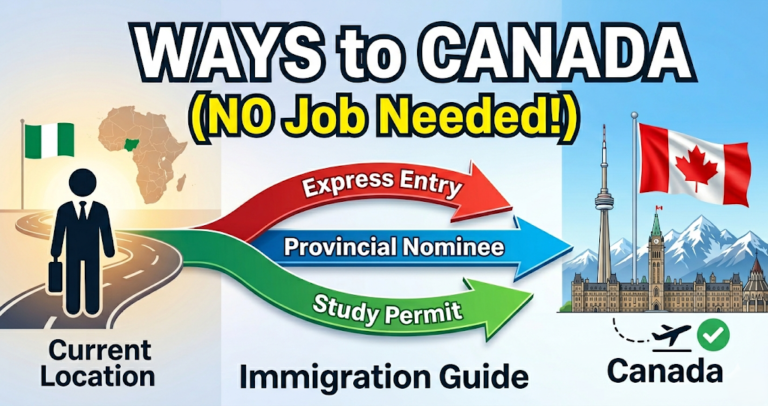
Many Nigerians believe you cannot move to Canada unless a Canadian employer has already offered you a job. That is not true.
While having a job offer can improve your chances, it is not mandatory for many popular pathways – especially for skilled workers.
In fact, the majority of people who receive permanent residence in Canada each year do so without any employer involvement, especially through the Express Entry system.
Canada’s immigration system is designed to assess you on your skills, education, language ability, and adaptability – not just on whether you already have a job lined up.
If you are a Nigerian professional, recent graduate, or skilled worker wondering how to immigrate to Canada without a job offer, this guide is for you.
I will walk you through the best options available, requirements, and practical steps to increase your chances of success.
Can You Move to Canada Without a Job Offer?
Yes, you can.
Many people successfully immigrate to Canada every year without a job offer through programs like:
- Express Entry
- Provincial Nominee Programs (PNPs)
- Study pathway (student visa → work permit → PR)
The key is meeting eligibility requirements and having a strong profile.
Best Ways to Immigrate to Canada Without a Job Offer
Canada offers several immigration programs that do not require a job offer. The most common ones for Nigerians are:
Express Entry System (Most Popular)
Express Entry is Canada’s fast-track system for skilled workers. It manages three programs: Federal Skilled Worker Program (FSWP), Canadian Experience Class (CEC), and Federal Skilled Trades Program (FST).
For most applicants coming from outside Canada, the Federal Skilled Worker Program (FSWP) is the best option because it does not require a job offer or Canadian work experience.
Basic Eligibility for FSWP:
- At least 1 year of continuous full-time skilled work experience (NOC TEER 0, 1, 2, or 3) in the last 10 years
- Minimum language level of CLB 7 (IELTS 6.0 in each band or equivalent)
- Education equivalent to at least a Canadian high school diploma (get an Educational Credential Assessment – ECA)
- Score at least 67 points on the Federal Skilled Worker selection grid (factors include age, education, language, work experience, and adaptability)
- Proof of funds: You must show you have enough money to support yourself and your family after arrival, unless you have a valid job offer or are applying under the Canadian Experience Class (CEC).
Once eligible, you create an Express Entry profile and enter the pool. IRCC then issues Invitations to Apply (ITAs) based on your Comprehensive Ranking System (CRS) score.
Note on CRS in 2026: As of March 2025, job offers no longer give extra CRS points. This levels the playing field for applicants without offers. Your score now depends heavily on age (maximum under 30), education (especially Canadian or high-level degrees), strong language scores (especially French + English), and work experience.
Category-based draws also target specific occupations or French speakers, which can help even without a job offer.
Provincial Nominee Programs (PNP) Without Job Offers
Many provinces nominate candidates for permanent residence through streams that don’t require a job offer, especially if you have an Express Entry profile.
Some active or notable no-job-offer streams include:
- Alberta Advantage Immigration Program (priority sectors like construction, agriculture, aviation)
- Manitoba Skilled Worker Overseas (needs connection to Manitoba – family, previous study/work, or invitation)
- Nova Scotia Nominee Program Express Entry streams
- Ontario Human Capital Priorities (through Express Entry)
- Other provinces like PEI, Saskatchewan (check current status as some streams pause), and British Columbia have human capital or skills-based streams
| Province | No‑Job‑Offer PNP Stream | Key Requirement |
|---|---|---|
| Ontario | Human Capital Priorities Stream | Active Express Entry profile + CRS score + occupation in demand. |
| Alberta | Alberta Express Entry Stream – Priority Sectors | CRS score of at least 300 + work experience in construction, agriculture, aviation, or manufacturing. |
| Saskatchewan | International Skilled Worker – Occupations In‑Demand | Occupation on SINP’s in‑demand list + ECA + language test. |
| Nova Scotia | Labour Market Priorities Stream | Invited directly from the Express Entry pool based on occupation or experience criteria. |
| Manitoba | Skilled Worker Overseas Stream | At least 60 points on MPNP grid + connection to Manitoba (family, education, past work, or invitation). |
| Prince Edward Island | PEI PNP Express Entry Stream | Active Express Entry profile + genuine intention to live in PEI. |
A provincial nomination gives you 600 extra CRS points, which almost guarantees an ITA in most draws.
Each province updates its streams and requirements regularly. Always check the official PNP website of the province you are targeting before applying.
Study in Canada Pathway
One of the smartest long-term strategies is to come as an international student.
After graduating, you can get a Post-Graduation Work Permit (PGWP), gain Canadian work experience, and then apply through Canadian Experience Class (CEC) or enhanced PNP streams – all without needing an initial job offer to enter the country.
This route is popular because Canadian education and work experience boost your CRS score significantly.
- Apply to a Canadian school
- Get a study permit
- Work part-time during studies
- Apply for a Post-Graduation Work Permit (PGWP)
- Transition to permanent residence
This route does not require a job offer at the start, but you will need to show proof of funds for tuition and living expenses.
Explore Family Sponsorship
If you have a spouse, common‑law partner, parent, or child who is a Canadian citizen or permanent resident, they can sponsor you for permanent residence.
The best part? There is no minimum income requirement for spousal sponsorship. The sponsor does not need a job. IRCC’s priority is family reunification, not the sponsor’s employment status.
Basic requirements for the sponsor:
- Be at least 18 years old.
- Be a Canadian citizen or permanent resident.
- Live in Canada (or show intent to return if living abroad).
- Sign an undertaking to provide basic financial support for the sponsored spouse for 3 years.
If the sponsor is unemployed, they can still be eligible. IRCC will look at savings, assets, and family support and provide a detailed explanation of how they plan to support the couple.
Other Pathways
- Start-Up Visa: For entrepreneurs with innovative business ideas supported by designated Canadian organizations.
- International Experience Canada (IEC): Working Holiday visa (for young people from eligible countries) lets you work in Canada temporarily without a job offer, then transition to PR later.
Step-by-Step Guide: How to Immigrate to Canada Without a Job Offer
- Assess Your Eligibility: Use the official IRCC tools to check if you qualify for Express Entry or any PNP.
- Improve Your Profile: Take language tests (IELTS/CELPIP/TEF), get an ECA for your credentials, and gather work experience proofs.
- Create Express Entry Profile: Enter the pool and monitor draws.
- Research PNPs: Check provincial websites regularly for streams that match your profile.
- Gather Funds: Show proof of settlement funds (unless you have a valid job offer or Canadian experience).
- Submit Application: When you get an ITA, prepare and submit a complete PR application with all documents.
- Wait for Decision: Processing times vary, but Express Entry is usually the fastest.
Prepare Your Documents
Regardless of which pathway you choose, you will need:
- Language test results (IELTS General / TEF / CELPIP) – valid for 2 years.
- Educational Credential Assessment (ECA) – from an IRCC‑approved organisation (WES, ICES, IQAS, etc.).
- Police clearance certificates – from any country where you have lived for 6 months or more since age 18.
- Medical exam results – from an IRCC‑approved panel physician.
- Proof of funds (if required).
- Birth certificate, marriage certificate, and other family documents.
Do not start an application without having these ready or in progress. Incomplete or rushed applications are a common reason for refusal.
Extra Tips and Insights from Real Experience
- Do not use an unauthorised agent. You can apply yourself.
- Maximize Your CRS Score: Being under 30, having a Master’s or PhD, scoring CLB 9+, and having strong French can push your score higher even without Canadian ties.
- Language is King: Many draws now favour bilingual candidates. Learning French gives a massive advantage.
- Be Honest and Accurate: Mistakes or misrepresentations can lead to bans. Use a regulated immigration consultant (RCIC) if your case is complex.
- Settlement Funds: For FSWP, you need to prove you can support yourself and family (amounts change yearly – check IRCC site).
- Timeline: From creating a profile to landing can take 6–24 months, depending on your score and pathway.
- Proof of funds must be “seasoned.”: Do not deposit a large sum of money into your account one week before applying. Keep the money in your account for at least 6 months before applying, or provide clear documentation of its source (e.g., sale of property, gift deed from parents).
- Check your NOC code before applying: Your job title in Nigeria may not match the Canadian NOC system. Research carefully and choose the NOC code that best fits your actual duties.
- Current Reality in 2026: Competition is high. Some PNP streams without job offers have paused or become very selective. Focus on building a strong core profile rather than chasing every draw.
Sample Timeline for a Strong Candidate
- Months 1 to 2: Language test + ECA
- Month 3: Create Express Entry profile
- Months 4 to 8: Receive ITA (if CRS is competitive) or apply to PNP
- Months 9 to 18: PR approval and landing in Canada
Common Myths About Immigrating Without a Job Offer
- Myth 1: “I need a Canadian employer to sponsor me.”: No. The majority of Express Entry invites go to candidates without job offers.
- Myth 2: “IRCC removed points for job offers, so now it’s harder.”: Actually, the removal of extra points for job offers (as of March 25, 2025) made the system more fair for candidates without Canadian employers.
- Myth 3: “PNP always requires a job offer.”: False. Many provinces have no‑job‑offer streams, as shown in the table above.
- Myth 4: “I can just borrow the proof of funds.”: Do not do this. IRCC can refuse your application if the funds are obviously borrowed or if you cannot explain the source.
FAQs
Conclusion
Understanding how to immigrate to Canada without a job offer opens up more opportunities than many people realize.
While a job offer can help, it is not required for major pathways like Express Entry and some Provincial Nominee Programs.
Focus on building a strong profile – good education, work experience, and a high language test score – and your chances of success will increase significantly.
With the right approach, you can successfully relocate to Canada and start a new chapter, even without securing a job beforehand.
