Healthcare is one of the few industries where the demand conversation is essentially settled. Populations are aging, chronic conditions are rising, and no government or economy has figured out how to run a health system with fewer people.
If job security is a priority for you, healthcare starts with a structural advantage that most other fields don’t have.
But “healthcare is stable” is also the most generic career advice on the internet. What actually matters is which role you’re considering, what it realistically pays, what it costs you in training time and emotional energy, and whether the day-to-day work suits how you’re built.
Here’s the honest breakdown.
What Healthcare Careers Actually Cover
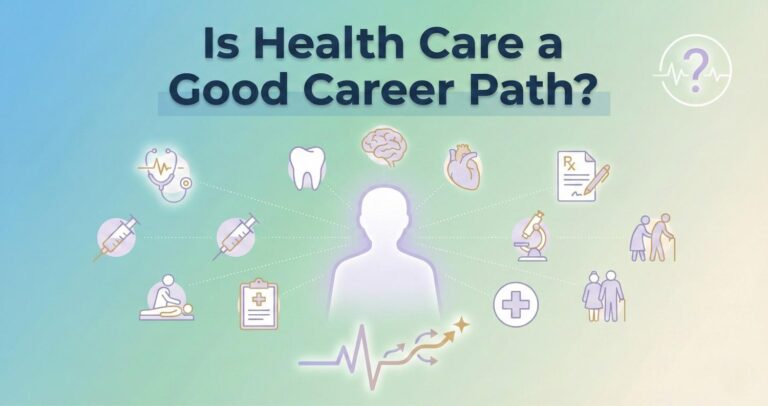
Healthcare is not one career – it’s a broad ecosystem. The clinical side includes roles like nursing, medicine, pharmacy, physiotherapy, and laboratory science.
The non-clinical side includes healthcare administration, health informatics, medical coding, and public health management.
This distinction matters because the training requirements, salary ranges, and day-to-day realities are completely different. A medical assistant and a physician both work in healthcare, but comparing them is like comparing a paralegal to a senior partner.
What Healthcare Roles Pay
| Role | Average Salary (US) | Education Required |
|---|---|---|
| Medical Assistant | $35,000 – $45,000 | Certificate (1 year) |
| Registered Nurse (RN) | $75,000 – $95,000 | Associate or Bachelor’s degree |
| Pharmacist | $120,000+ | Doctor of Pharmacy (PharmD) |
| Healthcare Manager | $100,000 – $130,000 | Bachelor’s or Master’s |
| Physical Therapist | $85,000 – $100,000 | Doctoral degree (DPT) |
| Physician | $200,000 – $350,000+ | Medical degree + residency |
The salary ceiling in healthcare is genuinely high – but so is the education investment required to reach it. The roles with the lowest barriers to entry (medical assistant, phlebotomist, health aide) also have the lowest pay.
That’s not a reason to avoid healthcare, but it’s a reason to be specific about which role you’re targeting before deciding whether the path is worth it for you.
Registered Nurse
Nursing is the most practical entry point into clinical healthcare for most people. An Associate Degree in Nursing (ADN) takes about two years, and many nurses later complete a Bachelor of Science in Nursing (BSN) while working.
The BLS consistently reports nursing among the fastest-growing occupations in the US, and the $75,000–$95,000 average salary understates what experienced nurses in high-demand specialties or locations can earn.
The work is physically and emotionally demanding – 12-hour shifts, direct exposure to patient distress, and high-stakes decisions under pressure are standard.
Nurses who thrive in the role tend to have both clinical competence and genuine emotional resilience. It’s not a career where you can check out mentally and still perform well.
Physician
The income potential is exceptional – primary care physicians earn $200,000+, specialists regularly exceed $300,000 – but the path is long and expensive. Medical school alone is four years after a bachelor’s degree, followed by residency (3–7 years depending on specialty), and in some cases, fellowship training beyond that.
Many physicians don’t reach fully independent practice until their early-to-mid thirties.
For people who are certain about the commitment and can manage the financial and time investment, medicine remains one of the highest-ceiling careers available. For those who want high income faster, other healthcare roles offer better returns on training time.
Healthcare Manager
If you want to work in healthcare without working directly with patients, administration and management is the lane. Healthcare managers oversee facility operations, staffing, compliance, budgets, and service delivery – it’s where business skills meet the health system.
Many healthcare managers come from clinical backgrounds and transition into administration mid-career. Others enter through business or public health degrees.
The earning range of $100,000–$130,000 reflects genuine senior responsibility, and the role is largely desk-based – a meaningful difference if clinical environments aren’t where you want to spend your day.
The Growth Areas Worth Paying Attention To
Not all healthcare specialties are growing at the same rate. The areas with the strongest projected demand over the next decade include mental health services, elder care and geriatrics, telehealth and remote patient monitoring, and health informatics.
These aren’t niche roles – they’re expanding rapidly and, in the case of mental health particularly, are still significantly understaffed relative to demand.
Telehealth is also worth noting specifically for anyone who wants healthcare work without the traditional hospital or clinic environment.
Remote clinical roles are increasingly available for nurses, therapists, and health coaches – a genuinely different working model than what healthcare looked like ten years ago.
The Real Costs of a Healthcare Career
The standard list of healthcare cons – long hours, emotional stress, licensing requirements – is accurate but undersells the reality for some roles. Clinical burnout is a documented problem across nursing and physician workforces globally, not an occasional risk.
The emotional weight of working with sick, dying, or suffering patients is something you either have the capacity to manage or you don’t, and no amount of salary compensates for it if you don’t.
Licensing and continuing education requirements also mean the learning doesn’t stop at qualification. Most clinical roles require ongoing certification renewal, which takes time and money throughout your career – not just at the start.
One factor that rarely gets mentioned honestly: pay varies dramatically by country. A registered nurse in the US or UK earns significantly more than the same role in Nigeria or most of sub-Saharan Africa.
For healthcare professionals in lower-paying markets, migration to higher-paying healthcare systems is a real and common career strategy – and worth factoring into your planning if you’re weighing the investment in training.
Is Healthcare the Right Career Path for You?
Healthcare suits people who want work that matters, can handle responsibility and pressure, and are willing to invest in meaningful training upfront.
The job security argument is real – demand for healthcare workers is not going to decline – and the earning potential across mid-to-senior roles is genuinely strong.
It’s a harder fit for people who want fast entry into high income, strong work-life boundaries from the start, or careers that can be built entirely remotely from day one. Those priorities aren’t wrong – they just point toward different fields.
The most useful question isn’t “is healthcare a good career path” – it’s “which healthcare role fits my timeline, my temperament, and my income goals.” Start there, and the answer becomes much clearer.
