
Most freelancers learn the hard way why contracts matter. A client disappears after delivery.
A project scope expands to three times what was originally discussed with no additional pay. Payment terms that were agreed verbally are suddenly “misremembered” when the invoice arrives.
These situations aren’t rare – they’re predictable consequences of starting work without a written agreement in place.
A freelance contract doesn’t need to be a 20-page legal document to be effective. It needs to be clear, specific, and signed before any work begins.
Here’s what to include, how to structure it, and what most freelancers leave out that causes problems later.
Why Every Freelance Project Needs a Written Contract
Verbal agreements feel sufficient in the moment – both parties are enthusiastic, the relationship is new, and raising a formal contract can feel like introducing distrust into a conversation that’s going well.
That discomfort is worth pushing through every time. Memory is selective, circumstances change, and what seemed like a clear agreement becomes genuinely disputed when money is on the line.
A written contract does three things a verbal agreement can’t. It creates a shared written record of exactly what was agreed, which eliminates most disputes before they start.
It establishes your professional credibility – clients who work with experienced freelancers expect contracts, and presenting one signals that you operate at a professional level.
And it gives you legal standing if you need to pursue payment or defend your work, neither of which is possible without documentation.
Contracts also protect clients, which is worth acknowledging in the conversation. A clear scope of work protects them from being billed for work they didn’t request. Clear revision terms protect them from open-ended projects.
A professional agreement on both sides creates the conditions for a working relationship that actually functions well.
What to Include in a Freelance Contract
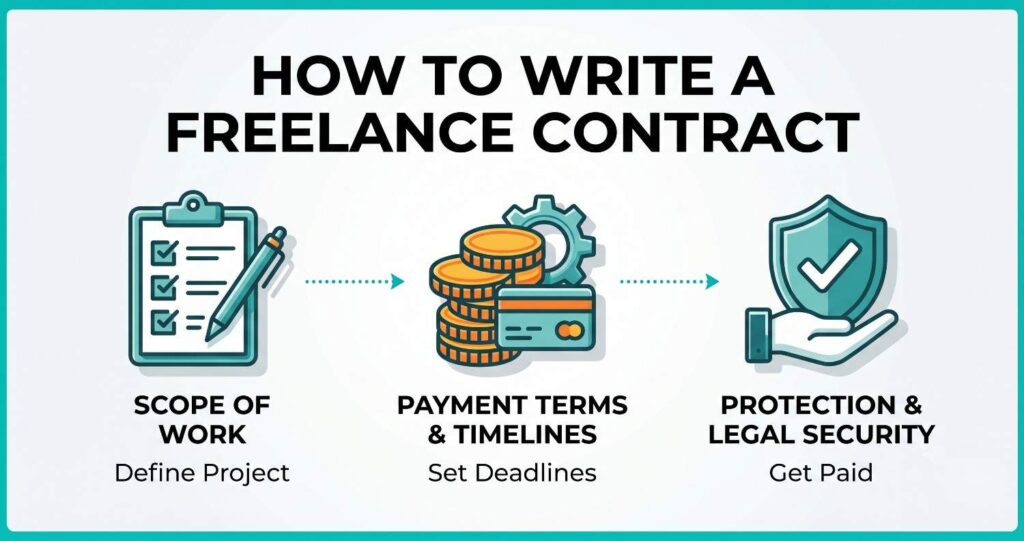
1. Parties and Project Identification
Start with the full legal names and contact information of both parties – your name or business name and the client’s name or company name. Include the date the contract is being entered into and a brief project title or reference.
This section is administrative but important: it establishes who is bound by the agreement and creates an unambiguous reference point for everything that follows.
2. Scope of Work
This is the most important section of any freelance contract, and the one most likely to cause problems if it’s vague.
The scope of work describes exactly what you will deliver – not in general terms, but specifically.
Not “website copy” but “copy for five website pages: Home, About, Services, Blog, and Contact, each between 300 and 500 words.” Not “social media management” but “ten Instagram posts per month, including captions and hashtags, scheduled in advance using the client’s approved scheduling tool.“
Equally important is what the scope does not include. If the project is a logo design, the contract should specify that it does not include brand guidelines, social media assets, or business card design unless those are separately agreed and priced.
Scope creep – the gradual expansion of a project beyond its original boundaries – is the most common source of undercompensation in freelancing, and it almost always starts with a scope section that was too broad or left too much undefined.
3. Deliverables and Timeline
List the specific deliverables – the actual files, documents, or outputs you’ll provide – and the timeline for each. If the project has multiple phases, break the timeline down by phase rather than giving a single end date.
Be specific about file formats where relevant: a designer should specify whether they’re delivering print-ready PDFs, editable source files, web-optimized versions, or all three.
Include a clause that makes your timeline contingent on timely client feedback and approvals. If a client takes three weeks to review a draft, your delivery date shifts accordingly.
This is a reasonable and professional position – without it, you’re absorbing the cost of client delays in the form of missed deadlines that look like your fault.
4. Payment Terms
Specify the total project fee or your rate, the payment schedule, and the accepted payment methods. For most freelance projects, a deposit of 25–50% upfront before work begins is standard and protects you from completing a project and then chasing payment.
The remainder can be due on delivery, on approval, or on a specific date – whatever you’ve agreed; write it explicitly.
Include late payment terms – a specific fee or interest rate that applies if payment isn’t received by the due date. Most freelancers never enforce these, but their presence in a contract changes client behavior in a way that vague payment terms don’t.
Also specify what happens to the project if payment isn’t received – most standard freelance contracts include a clause stating that ownership of the work remains with the freelancer until payment is made in full.
5. Revisions and Change Requests
Define how many rounds of revisions are included in the project fee and what constitutes a revision versus a new request. A revision is a change to what was already delivered – adjusting a headline, changing a color, shortening a paragraph.
A new request is something outside the original scope – a new page, a new feature, a different design direction.
Without this distinction in writing, “just one more small change” can accumulate into unpaid hours.
Specify your rate for additional revisions or out-of-scope requests so both parties know in advance what additional work costs.
This makes the conversation much easier when a client asks for something beyond the original scope – you’re not improvising a rate on the spot; you’re referencing a number you both already agreed to.
6. Intellectual Property and Ownership
Specify when and how ownership of the work transfers to the client. The standard position for most freelancers is that copyright remains with the creator until payment is received in full, at which point ownership transfers to the client.
This is a legitimate and widely used position – it gives you meaningful leverage if a client doesn’t pay, because you own the work and they can’t legally use it.
If the client needs to own the work from the moment it’s created – which some larger clients require – this is worth pricing into the project fee, since you’re giving up certain default creator rights.
Also clarify whether you retain the right to display the work in your portfolio, which most clients will agree to unless the project is confidential.
7. Confidentiality
If the project involves access to sensitive business information, client data, or proprietary processes, include a basic confidentiality clause committing you not to share that information with third parties.
Many clients – particularly larger companies – will ask for this as a matter of course. Having it in your standard contract template means you’re not scrambling to add it when a client requests it.
8. Termination Clause
Define what happens if either party needs to end the project before completion. A standard termination clause gives both parties the right to terminate with reasonable notice – typically 14 to 30 days – and specifies that you’re paid for all work completed up to the termination date.
For projects paid with a deposit, specify whether the deposit is refundable if the client terminates early, and under what conditions.
Without a termination clause, a client who decides to cancel a project midway has no defined obligation to pay for work already completed, and you have no clear basis for claiming it.
This is one of the clauses that feels unnecessary until you need it.
9. Governing Law
Specify which country and state or jurisdiction’s law governs the contract. This matters if there’s ever a dispute – it determines where and how any legal proceedings would take place.
For most freelancers working with clients in the same country, this is straightforward.
For international client relationships, it’s worth being explicit about whose law applies and where disputes would be resolved.
How to Format and Send Your Contract
Your contract doesn’t need to be formatted as a formal legal document to be enforceable – clear, plain language is preferable to legal jargon that neither party fully understands.
Tools like HelloSign, DocuSign, and PandaDoc allow both parties to sign digitally, which creates a timestamped record and removes the friction of printing and scanning. Most clients expect and prefer digital signatures.
Send the contract before you start any work and before you accept a deposit.
Make it clear – professionally, not aggressively – that work begins once the contract is signed and the deposit is received. This is a standard professional practice, and most legitimate clients expect it.
A client who resists signing a fair contract is giving you useful information about how the rest of the engagement is likely to go.
Common Mistakes Freelancers Make With Contracts
Starting work before the contract is signed is the most common and most costly mistake. It happens when a client seems trustworthy, the project is small, or the timeline feels urgent.
None of those are good reasons – a contract that takes 24 hours to sign is not a significant delay, and the risk of starting without one is not offset by any of those circumstances.
Using overly vague scope language is the second most common problem. “Website design” is not a scope. “Five-page website including Home, About, Services, Portfolio, and Contact, designed in Figma and delivered as a WordPress theme” is a scope.
The more specific your language, the less room there is for genuine or manufactured misunderstanding later.
Not including a revision limit is the third. Unlimited revisions sound generous in a pitch but produce projects that never end and clients who keep requesting changes because there’s no cost to doing so.
A defined revision limit with a clear rate for additional requests is better for both parties – it focuses feedback and respects both the client’s budget and your time.
Frequently Asked Questions
Conclusion
A freelance contract is not bureaucracy – it’s the foundation of a professional working relationship.
The clauses that feel unnecessary before a project starts are exactly the ones that matter when something goes wrong. A clear scope prevents scope creep. A defined payment schedule prevents late payment. A termination clause prevents unpaid work. An IP clause prevents disputes over who owns what.
None of these situations are hypothetical – they happen regularly to freelancers who work without contracts and rarely to those who don’t.
Start with a solid template that covers the nine elements above, customize it for each project’s specific scope and terms, and make signing it a non-negotiable step before any work begins.
The few minutes it takes to prepare and send a contract are among the highest-return minutes in any freelance business – they protect your income, define the project clearly, and set the professional tone for everything that follows.
