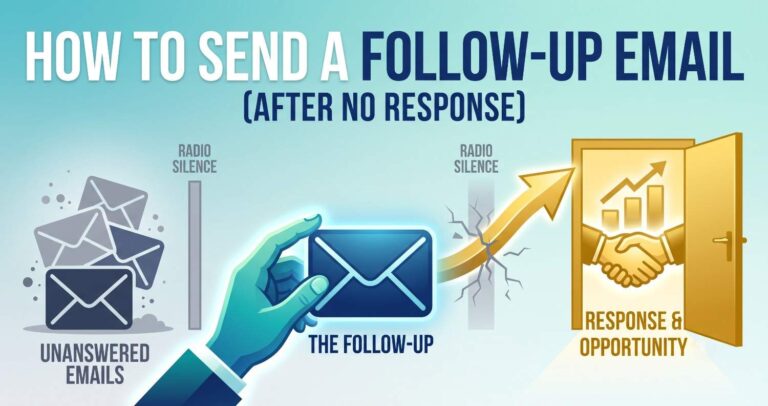
Sending something important – a job application, an interview thank-you, a proposal – and then hearing nothing back is one of the more frustrating experiences in professional life.
You don’t know whether your message was received, whether it’s sitting in a queue, or whether the answer is simply no and nobody wants to say so.
Following up feels necessary but also risky – what if it comes across as pushy or desperate?
The risk is real but manageable. A well-timed, professionally worded follow-up email after no response rarely damages a relationship and frequently produces a response that wouldn’t have come otherwise.
The candidates and professionals who follow up consistently and well tend to outperform those who wait indefinitely – not because persistence alone produces results, but because most non-responses are logistical rather than intentional, and a single follow-up resolves them.
Why You’re Not Getting a Response
Before writing a follow-up, it’s worth understanding why the silence happened in the first place – because the reason affects both the timing and the tone of your follow-up.
Most non-responses in hiring and professional contexts are not deliberate rejections. Recruiters managing twenty open roles simultaneously miss emails. Applications get filtered by ATS systems before a human sees them.
Hiring decisions get put on hold without anyone updating candidates. Interviewers intend to follow up and get pulled into other priorities. A hiring manager who said you’d hear back in a week said it genuinely and then had a chaotic week that pushed the follow-up off their list.
Understanding this changes how you approach the follow-up. You’re not confronting someone who has deliberately ignored you – you’re providing a gentle prompt that makes it easy for a busy person to re-engage with something they meant to but didn’t.
That framing produces better-worded emails and a more confident tone than assuming the silence was a deliberate slight.
When to Send a Follow-Up Email After No Response
Timing is the most important variable. Following up too early signals impatience; following up too late loses the window of relevance.
The right timing depends on what you sent and what context was established before the silence.
| Situation | Wait Before Following Up | Maximum Follow-Ups |
|---|---|---|
| Job application, no prior contact | 1-2 weeks | 2 |
| Post-interview, timeline given | After stated timeline passes + 2 days | 2 |
| Post-interview, no timeline given | 7-10 business days | 2 |
| Recruiter reached out, you applied | 5-7 business days | 2 |
| Professional networking email | 5-7 business days | 1-2 |
| Proposal or quote sent to a client | 3-5 business days | 2-3 |
The timeline stated by an interviewer is your most reliable anchor. If they said you’d hear back within a week, wait until that week has passed plus two additional business days before following up – the extra buffer accounts for the fact that stated timelines frequently slip by a day or two without any negative meaning.
Following up the day the stated window closes reads as impatient; following up two days after it reads as reasonably responsive.
How to Write a Follow-Up Email After No Response
The structure of an effective follow-up email after no response is consistent regardless of the context: a brief, clear subject line that identifies what you’re following up on, a short opening that references the previous communication, a single sentence reiterating your interest or the purpose of your follow-up, and a clear close that makes it easy for the recipient to respond.
That’s it – four elements, rarely more than three to four sentences total.
What consistently undermines follow-up emails is over-explanation.
Candidates who write a paragraph apologizing for following up, another paragraph re-explaining their qualifications, and a third paragraph asking for a response are making the recipient do more work than a simple “yes, we’re still in process” or “sorry, we went in a different direction” requires.
Shorter emails get more responses than longer ones when the purpose is simply to prompt a reply.
Follow-Up Email After a Job Interview With No Response
This is the most common scenario candidates need to navigate – you had an interview, it went well by your read, and the timeline the interviewer mentioned has passed without any communication. Here’s a follow-up that works:
Subject: Following Up – [Job Title] Interview
Hi [Name],
I wanted to follow up on our conversation about the [Job Title] role on [date]. I remain genuinely enthusiastic about the position and the team, and I wanted to check whether there’s been any update on the timeline.
Please let me know if there’s anything additional I can provide. I look forward to hearing from you.
Best,
[Your Name]
If this first follow-up doesn’t receive a response within another week, a second and final follow-up is appropriate:
Subject: Re: [Job Title] Interview – Final Follow-Up
Hi [Name],
I wanted to send one final note to reiterate my strong interest in the [Job Title] role. I understand you may be working through a busy period, and I don’t want to be a burden – I just wanted to ensure my continued enthusiasm is on record.
If the role has been filled or the process has moved in a different direction, I completely understand. Either way, I appreciated the opportunity to learn more about [Company Name] and the team.
Best,
[Your Name]
This second email does something the first doesn’t – it gives the recipient an easy exit by acknowledging the possibility that the role is filled or the process has moved on.
This often prompts a response from hiring managers who have been meaning to send a rejection but kept putting it off, because you’ve made it easy for them to close the loop.
Follow-Up Email After a Job Application With No Response
Following up on a cold application – one where you had no prior contact with anyone at the company – is lower-probability than following up after an interview, but still worth doing once.
The key is finding a specific person to contact rather than sending to a generic inbox, and keeping the message brief enough that responding takes less than thirty seconds.
Subject: Following Up – [Job Title] Application
Hi [Name],
I submitted an application for the [Job Title] position on [date] and wanted to follow up to confirm it was received and reiterate my strong interest in the role.
I’d welcome the chance to discuss my background further at your convenience. Please let me know if there’s any additional information I can provide.
Best regards,
[Your Name]
[Phone Number]
Follow-Up Email After Sending a Networking Message With No Response
Following up on a networking message requires a lighter touch than a job application follow-up, because the relationship doesn’t yet exist and the ask is less transactional.
One follow-up is appropriate; two is pushing it; three is almost always counterproductive regardless of how genuinely interested you are in connecting.
Subject: Re: [Original Subject Line]
Hi [Name],
I wanted to follow up on my previous message in case it got buried. I’d genuinely value the chance to connect – I’ll keep it brief and respect your time completely.
If now isn’t a good time, no pressure at all – I appreciate you considering it either way.
Best,
[Your Name]
The phrase “in case it got buried” is worth noting – it attributes the non-response to logistics rather than disinterest, which is both more accurate in most cases and less presumptuous than assuming the person received your message and chose not to respond.
It makes it easier for someone who did miss your original message to reply without awkwardness.
Common Follow-Up Mistakes to Avoid
Apologizing for following up is the most common one – “I’m sorry to bother you” or “I apologize for reaching out again” immediately undermines the confidence you’re trying to project. Following up professionally is a normal part of any hiring or business process.
You don’t need to apologize for it. A brief acknowledgment that the person is likely busy is considerate; an apology for existing in their inbox is self-defeating.
Sending follow-ups too frequently is the second most common problem. Sending a second email two days after the first when there’s been no response reads as anxious and poorly calibrated.
Give each follow-up adequate time to generate a response before sending another – at minimum five business days, often more depending on the context.
Three or more follow-ups without a response is almost always a signal to stop rather than a signal to try once more.
Varying the channel without reason – following up by email, then LinkedIn, then phone, within the same week – creates an impression of desperation rather than determination. Pick one channel, follow up twice with appropriate spacing, and then redirect your energy.
The exception is when someone has explicitly told you they prefer a specific communication method, in which case using that method is appropriate from the start.
When to Stop Following Up
Two follow-ups with no response is the general ceiling across most professional contexts. After that, continuing to reach out shifts from persistence to pressure – a distinction that’s obvious to the recipient even when it’s not obvious to the sender.
The absence of a response after two follow-ups is itself a form of communication: it tells you that this particular opportunity isn’t going to progress through your efforts, and that your time is better invested elsewhere.
Stopping at two doesn’t mean burning the bridge. Stay connected on LinkedIn if there’s a genuine professional reason to do so, and if a new opportunity opens at the same company in the future, a fresh application with a warm reference to your previous process is entirely appropriate.
The professional world is interconnected enough that maintaining low-key, respectful relationships even after they don’t produce an immediate result consistently pays off over longer timeframes than any single application cycle.
Frequently Asked Questions
Conclusion
A well-timed follow-up email after no response is one of the more straightforward professional skills to get right – the format is simple, the timing is predictable, and the upside of doing it well consistently outweighs the risk of doing it at all.
The candidates and professionals who follow up consistently and confidently tend to navigate hiring processes more effectively than those who either never follow up or follow up in ways that create the wrong impression.
Wait long enough that the timing is appropriate, keep the email short enough that responding takes thirty seconds, and stop at two follow-ups without a response.
That framework applies across job applications, post-interview follow-ups, and professional networking equally – and the candidates who apply it consistently find that the professional world is more responsive to genuine, well-timed outreach than the silence often suggests.
