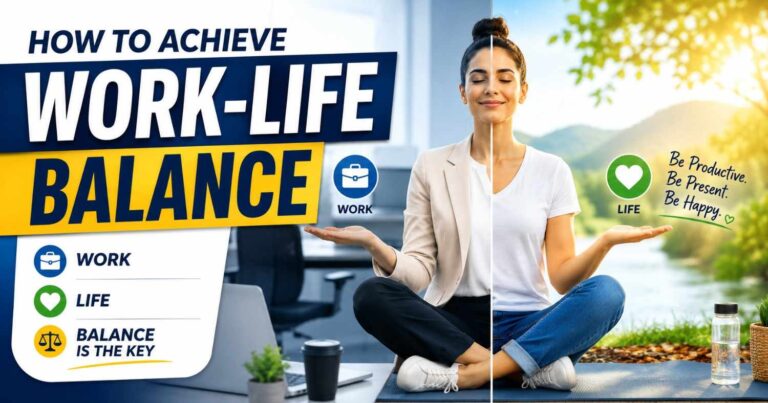
Work-life balance is one of those phrases that gets used so frequently it has started to mean almost nothing. It appears in company values statements, job postings, and career advice articles in ways that are rarely followed by anything specific enough to be actionable.
Most people know they want it; far fewer have a clear picture of what it actually looks like in their specific life, or how to build it within the real constraints of their job and their industry.
The useful reframe is to stop thinking about balance as a state to achieve and start thinking about it as a set of deliberate ongoing decisions about how you allocate your finite time and energy.
That reframe is less inspiring than the concept but more accurate – and it points toward practical actions rather than aspirational goals.
Why Work-Life Balance Is Harder Than It Used to Be
The structural conditions that made work-life separation easier in previous generations have largely eroded. When work happened in a physical location, and communication required a phone call, the end of the workday had a natural boundary.
The widespread adoption of smartphones, always-on communication tools, remote and hybrid work, and the normalization of after-hours email responsiveness have collectively dissolved that boundary for a significant proportion of professional workers.
The result is a working environment where the question “are you available?” has a default answer of yes for many people – not because they’ve agreed to that, but because the technological infrastructure makes availability the path of least resistance.
Achieving genuine work-life balance in this environment requires actively constructing the separation that used to exist structurally, which is harder work than it sounds when the professional culture of many organizations implicitly rewards constant availability.
Remote work adds a specific complication: when your home is also your office, the psychological transition between work mode and personal mode that a commute or office departure previously provided has to be manufactured rather than experienced.
Many people who work remotely report that work expands to fill all available time precisely because the natural stopping cues have been removed.
Define What Balance Means for You Specifically
The first practical step is one most people skip: defining what work-life balance actually looks like in your specific life rather than in the abstract.
Balance is not the same for everyone – a parent of young children has different non-negotiables than someone at a different life stage, a person with significant health considerations has different requirements than someone without them, and someone who genuinely loves their work has a different relationship to working hours than someone who views work primarily as a means to an end.
The questions worth answering honestly before designing any strategy: What specific things in your personal life are currently being compromised by work that you want to protect? What hours or times of day matter most to you for non-work activities? What does sustainable look like in terms of total weekly hours – not ideal, but genuinely sustainable over months rather than weeks? What are you not willing to give up, and what are you actually fine trading off even if it doesn’t sound noble?
Those answers produce a specific picture of what balance means for you, which is the prerequisite for any strategy that has a realistic chance of working.
Generic work-life balance advice fails most people, not because the advice is wrong but because it isn’t calibrated to the specific life the person is actually living.
Set and Communicate Working Hours
Defining your working hours and communicating them explicitly is the foundational boundary for most professional work-life balance problems. Most people with poor work-life balance have never clearly stated – to their manager, their team, or their clients – what hours they’re available and what their response time expectations are outside those hours.
Without that clarity, the default expectation is often availability whenever someone reaches out, which is a boundary that never existed in the first place rather than one that’s being violated.
Communicating working hours doesn’t require a dramatic announcement – it’s usually as simple as adding your hours to your email signature, setting calendar availability to reflect your actual working hours, and using out-of-office or status indicators consistently when you’re not working.
The communication signals to colleagues and managers that you have defined hours, which gradually shifts the expectation from constant availability to responsive-within-working-hours.
The harder conversation is when your working hours conflict with an organizational culture of after-hours responsiveness.
In those environments, the boundary-setting conversation needs to happen directly with your manager rather than through passive signals – a discussion about what level of after-hours availability is genuinely necessary versus what is a cultural habit that nobody has explicitly examined.
Many managers, when asked directly, are more flexible on this than their behavior suggests – they respond after hours because others do, not because the business genuinely requires it.
Create Structural Separation Between Work and Personal Time
The psychological transition between work mode and personal mode doesn’t happen automatically when work is always accessible through a device in your pocket.
Creating that transition requires deliberate structural choices – specific end-of-day rituals, physical or digital separation of work tools from personal ones, and consistent signals that the work day has ended.
End-of-day rituals don’t need to be elaborate – a consistent sequence of closing work applications, writing a brief note of what you’ll pick up tomorrow, and physically moving away from your workspace is enough to create the psychological signal that work has ended.
The consistency matters more than the specific ritual – doing the same thing every day at the end of work trains your brain to associate those actions with switching off in the same way that leaving an office building used to.
Physical separation helps where it’s possible. A dedicated workspace that you leave at the end of the day – even if it’s a corner of a room rather than a separate room – is more effective than working from a laptop on the couch that you then watch television on.
When the same physical space and device serve both work and personal functions, the psychological separation is harder to maintain.
Separate work and personal browser profiles, separate devices where affordable, and intentional removal of work email from your personal phone during non-working hours all reduce the friction of the boundary.
Manage Your Calendar Before Others Manage It for You
An unmanaged calendar fills with other people’s priorities. A managed calendar reflects your own.
The practical difference is whether you’re proactively blocking time for the work and recovery that matters most to you, or whether you’re reactively accepting whatever requests arrive and fitting your priorities into the gaps.
Blocking time on your calendar for focused work, personal commitments, and recovery isn’t just a productivity strategy – it’s a boundary-setting mechanism.
A calendar slot marked as unavailable is treated differently by colleagues scheduling meetings than an empty slot, and the habit of treating your own time with the same respect you’d give to an external commitment gradually shifts how others treat it as well.
Lunch breaks deserve particular attention here. In many professional environments, the working lunch has become so normalized that taking an actual break feels unusual.
The evidence on cognitive performance is consistent: uninterrupted focused work followed by genuine breaks produces better output than extended periods of low-quality sustained attention.
Protecting lunch as a genuine break – away from screens, away from work topics – is both a work-life balance practice and a performance practice.
Learn to Protect Non-Work Time Without Guilt
One of the less discussed but most practically significant barriers to work-life balance is the guilt that accompanies not working.
Many high-performing professionals carry a persistent low-level anxiety about whether they’re doing enough – checking email in the evening not because anything urgent has arrived but because not checking feels like falling behind.
That anxiety is the internal version of the boundary problem, and it’s harder to address than the external version because it doesn’t yield to structural changes alone.
The reframe that works for many people: rest and recovery are not rewards for sufficient work – they are inputs to sustained performance.
The cognitive and creative work that most professional roles require depends on mental recovery in the same way that physical performance depends on physical recovery.
A professional who never genuinely disengages from work is not more productive than one who protects recovery time – they’re typically less productive, and more vulnerable to the burnout that eventually forces the recovery that should have been taken voluntarily.
Treating non-work time as a performance input rather than a performance reward changes the guilt dynamic.
You’re not failing to work during personal time – you’re investing in the capacity to work well during working time.
That framing is more accurate than the alternative and produces better outcomes for the same reason that evidence-based approaches generally outperform guilt-driven ones.
Have the Conversation With Your Manager
Many work-life balance problems persist longer than they need to because the employee has never explicitly raised them with their manager.
Managers frequently don’t know that a team member’s workload has become unsustainable, that the expectation of after-hours availability is affecting someone’s home life, or that a specific project or client is creating disproportionate stress – because those things aren’t visible from the outside unless someone says something.
Having a direct conversation about workload, hours, and expectations is professionally appropriate and frequently more productive than either suffering in silence or making unilateral changes that create confusion.
Frame the conversation around what sustainable looks like and what you need to maintain your performance quality over time – not around what you don’t want to do.
Most managers respond better to “I want to make sure I can sustain this quality of work over the next year – can we discuss what that requires?” than to “I need to stop working evenings.”
If your manager is the source of the imbalance – consistently creating after-hours demands, adding to workload without removing other priorities, or setting expectations that no sustainable working pattern can meet – that’s important information about whether the role or the organization is actually compatible with the balance you need.
Some environments are structurally incompatible with sustainable work, and the most effective work-life balance decision in those contexts is sometimes the decision to find a different one.
Practical Habits That Build Balance Over Time
Beyond the structural changes, a few specific habits consistently appear in the practices of people who maintain work-life balance effectively over extended periods.
Planning the next day’s priorities at the end of the current workday reduces the open loops that pull attention toward work during personal time – you’ve already decided what tomorrow looks like, so your brain doesn’t need to hold it in working memory during the evening.
Time-boxing tasks – allocating specific time slots for specific work rather than working until something is finished – creates natural stopping points that prevent work from expanding indefinitely.
Scheduling personal activities with the same commitment you’d give a work meeting treats them as genuine commitments rather than optional events that yield to work demands whenever they compete.
Learning to say no, or at minimum to negotiate scope and timeline when new demands arrive, is the habit that ultimately determines whether any of the other practices hold.
Work-life balance at the individual level is partly about the boundaries you set with yourself and partly about the boundaries you hold with the organizational demands that will consistently test them.
The former is a personal discipline problem; the latter is a communication and negotiation skill that improves with practice.
Frequently Asked Questions
Conclusion
Work-life balance is not something that happens to you when you find the right job or reach the right career stage – it’s something you build through consistent, deliberate decisions about how you allocate your time and energy and how you communicate those decisions to the people and organizations that make demands on both.
The structural conditions of modern professional work make those decisions harder than they used to be, which means the effort required to maintain balance is higher, not lower, than previous generations faced.
The practical starting point is specific rather than aspirational: define what balance means for your particular life, identify the two or three changes that would produce the biggest improvement, and implement those changes before trying to optimize everything simultaneously.
Work-life balance built through specific, sustainable changes holds up better than aspirational overhauls that collapse under the first significant work demand.
Start where the gap is largest, hold the change consistently, and build from there.
