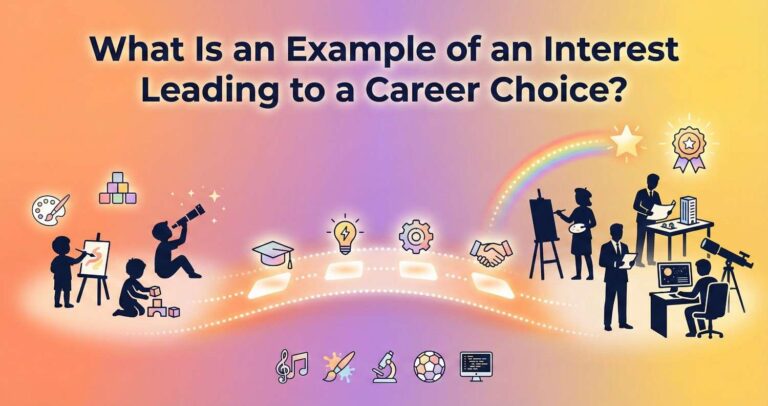
Most people don’t choose a career from a list – they follow something they were already drawn to. A kid who spends hours taking apart electronics becomes an engineer.
Someone who can’t stop reading about nutrition becomes a dietitian. The pattern is common enough that career counselors treat it as a starting framework: what you’re genuinely interested in is usually a reliable signal toward work you’ll actually sustain.
Here are real examples of how specific interests translate into career paths, and what that journey actually looks like in practice.
Interest in Technology → Software Developer or IT Professional
Someone who spends their free time building websites, modding games, or writing small scripts isn’t just playing around – they’re developing a technical intuition that formal education builds on rather than creates from scratch.
Many of the strongest software developers started with casual curiosity about how things work digitally, well before they wrote a single line of professional code.
The career path typically runs from self-teaching or a computer science degree through internships and portfolio projects to a full-time development role.
What makes technology a particularly accessible interest-to-career path is that the barrier between hobbyist and professional is lower than in most fields – a strong GitHub portfolio can open doors that a degree alone wouldn’t.
Interest in Helping People → Nursing or Social Work
People who are drawn to volunteering, who naturally step in when someone is struggling, or who find themselves genuinely energized by supporting others through difficulty tend to gravitate toward healthcare or social services – often without fully recognizing that’s what they’re doing.
Nursing is the most direct translation of this interest into a stable, well-paying career. The path involves a nursing degree (two to four years depending on the program), licensure exams, and clinical placement. Social work follows a similar route through a bachelor’s or master’s degree in social work.
Both careers require emotional resilience, but for people whose interest in helping others is genuine rather than idealized, the work tends to feel sustainable in a way that purely financial motivations don’t produce.
Interest in Art and Design → Graphic Designer or Creative Director
Creative interests have a harder commercial path than technical ones – the art market is genuinely competitive – but design sits at a practical intersection between creativity and business communication that pays reasonably well and has consistent demand.
Someone who enjoys drawing, visual composition, or digital art can develop those skills through formal design education or self-teaching with tools like Adobe Creative Suite, Figma, or Canva.
The portfolio matters more than the degree in most design hiring contexts. Freelancing often serves as both an income source and a portfolio builder early in the career, before moving into agency or in-house roles.
Senior designers who develop strategic thinking alongside visual skills can move into creative direction – a role that combines aesthetic judgment with team leadership and client management.
Interest in Business and Markets → Entrepreneur or Business Analyst
Some people are drawn to how businesses work – why some products succeed, how pricing decisions get made, what makes one company more profitable than another. This interest doesn’t always point toward starting a business.
It often leads equally toward business analysis, strategy consulting, or corporate finance roles where that market curiosity is genuinely useful.
For those who do pursue entrepreneurship, the path is less linear than the examples above. It typically involves building skills across multiple domains – marketing, operations, finance, sales – through both formal learning and hands-on experience, often starting with small ventures before scaling.
The interest in business has to be paired with tolerance for uncertainty and financial risk, which not everyone who finds markets interesting actually has.
Interest in Sports and Fitness → Physical Therapist or Strength Coach
Athletic interest doesn’t have to end with playing the sport. Many people who grew up in competitive sports find their real career fit in the support ecosystem around athletics – physical therapy, sports medicine, strength and conditioning coaching, or sports nutrition.
Physical therapy in particular offers strong income ($85,000–$100,000 average in the US) and meaningful work, but requires a doctoral degree (Doctor of Physical Therapy) – a significant time and financial investment. Strength and conditioning coaching has a lower barrier to entry through certifications like NSCA-CSCS, though the pay range is wider and more variable.
For someone whose interest in sports is specifically about human performance and recovery, these paths offer a way to stay connected to that world professionally.
Interest in Writing and Communication → Content Strategist or Journalist
People who read widely, write naturally, and care about how ideas are communicated have more career options than the traditional “journalist or novelist” framing suggests.
Content strategy, copywriting, technical writing, UX writing, and communications roles all draw heavily on the same underlying interest in language and clarity – and several of these pay significantly better than traditional journalism.
Content strategists at technology companies, for example, regularly earn $80,000–$120,000 working on how products communicate with users.
Technical writers who can translate complex information for non-expert audiences are consistently in demand across healthcare, finance, and technology sectors.
The writing interest is the foundation – the specific application determines the income ceiling.
Why Interest-Based Career Choices Tend to Work
The practical reason interest matters in career choice isn’t motivational – it’s about skill development. People who are genuinely interested in a field tend to spend more time on it voluntarily, which accelerates skill-building in ways that purely obligation-driven learning doesn’t replicate.
They read more, practice more, and notice more about their field than people who are just fulfilling requirements.
That compound effect shows up over time. A developer who codes for fun as well as work builds skills faster than one who closes the laptop the moment the workday ends.
A designer who follows the industry, experiments with new tools, and has opinions about visual trends develops judgment that a purely technical designer doesn’t.
Interest alone doesn’t guarantee career success – market demand, execution, and timing all matter. But as a starting signal for where to direct your energy and training investment, genuine interest is more reliable than salary lists or job security rankings.
How to Turn an Interest Into a Career Direction
The process isn’t complicated, but it requires honest self-assessment. Start by identifying what you actually spend time on voluntarily – not what you think sounds impressive or what your family expects, but what genuinely holds your attention.
Then research which careers sit closest to that interest and what those roles actually involve day-to-day, not just what they’re called.
From there, the path is skill-building: courses, certifications, projects, internships, or freelance work that gives you real experience in the field rather than theoretical knowledge about it.
Most career transitions from interest to profession happen through accumulated small steps rather than a single dramatic pivot.
The test worth applying at each stage: are you still voluntarily spending time in this area when nobody is making you? If yes, the interest is real, and the direction is worth pursuing. If the answer starts shifting to no, that’s useful information too.
Conclusion
Interests become careers when they’re paired with deliberate skill-building, real-world experience, and honest assessment of where market demand meets personal aptitude.
The examples above – technology, healthcare, design, business, sports, writing – all follow the same underlying pattern: sustained interest creates the motivation to develop skills deeply enough to get paid for them.
The starting point isn’t a career list. It’s an honest answer to what you’d spend time on even if nobody was paying you – and then figuring out who pays people to do that.
